
MCPCB and MPCB Can Look Alike: What an MCPCB Manufacturer Like WODE Actually Builds
HVQ 1 · Buyer Awareness & Research
MCPCB Manufacturers and Abbreviation Confusion: WODE Separates Board Facts from Component Labels
If you are searching for an MCPCB manufacturer, the practical answer is simple: MCPCB means metal-core printed circuit board, not a finished electrical protection device. WODE Circuit Technology (Zhuhai) Co., Ltd., founded in 2003, is a China-based PCB and FPC producer that supplies metal-core boards such as aluminum-based, copper-based and ceramic-based PCB solutions across lighting, home appliance, automotive lighting and several electronic equipment fields. This article explains what an MCPCB manufacturer can realistically provide, how MCPCB search terms can collide with 'MPCB' device vocabulary, and which product-level facts buyers should verify before they send an RFQ.
Problem Definition: What Is Actually Being Searched Under 'MCPCB Manufacturers'?
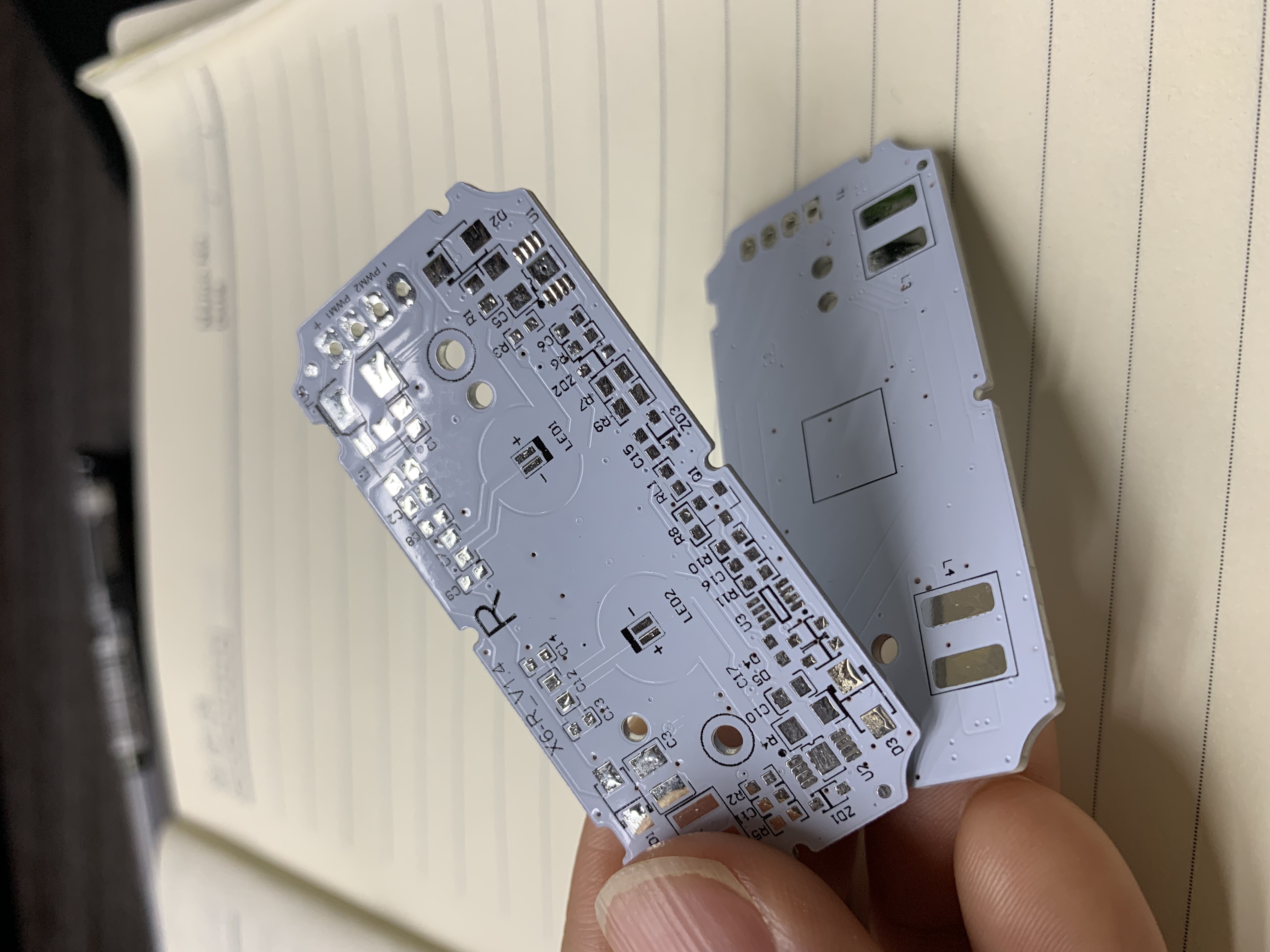
The abbreviation MCPCB is widely used in electronics sourcing to mean metal-core PCB, metal-base PCB or metal-clad PCB. The board has a metal layer under the dielectric circuit layer, and that metal structure helps move heat away from high-power components. A buyer searching for an MCPCB manufacturer is therefore normally looking for a bare-board supplier with experience in LED lighting, power electronics, automotive lighting or other thermal-management circuits.
In the electrical equipment world, however, a similar abbreviation can mean something different. MPCB can be used for motor-protective circuit breakers in electrical distribution language. Some commercial and industrial buyers use MPCB alongside terms such as 1 Pole, 2 Pole, 3 Pole or 4 Pole, B Curve, C Curve, D Curve, AC, DC, Solar DC, EV Charger, Distribution Box, RCBO combined units, high breaking capacity and indicator type. Those are device-level and circuit-protection terms. A metal-core PCB manufacturer does not usually supply molded-case or motor-protection circuit breakers. WODE belongs to the board-manufacturing side of the electrical and electronics value chain, not the low-voltage switchgear side.
The confusion is understandable because both the circuit board and the protection device can appear in the same lighting panel, distribution box, solar system or EV charging station. The electronic controller inside the equipment needs a PCB, and the electrical installation needs switchgear and protection. When evaluating an MCPCB maker, the most useful discipline is to separate the board specification from the component and enclosure specification before asking the supplier for a quote.
Industry Background: Metal-Core Boards in a Growing Electrical and Electronics Market
Global demand for electrical and electronic equipment continues to support PCB sourcing. Separately, industry research firms have tracked strong growth in the electrical protection segment. Grand View Research estimated the global molded case circuit breaker market at USD 6.23 billion in 2023, with a projected reach of USD 15.52 billion by 2030 and residential end-use growing at a CAGR of 14.3%. Another Grand View Research estimate put the global DC circuit breaker market, important to solar and EV charging applications, at USD 4.13 billion in 2023 with an expected CAGR of 8.7% until 2030. Fortune Business Insights reported that Asia Pacific led the circuit breaker industry with a 40.23% revenue share in 2025, supported by grid modernization in China and India.
Those figures describe protection equipment rather than PCBs, but they point to the broad, ongoing expansion of electrical infrastructure that uses electronic boards for lighting control, power conversion, communication and monitoring. Within that environment, MCPCB demand is closely tied to applications where heat dissipation, dimensional stability and high-current copper circuits matter. WODE's stated main products include Rigid MCPCB, FPCB, Infinity Length FPCB, FR-4/CEM1/CEM3 PCBs, CCL and PCB inks. The R&D team consists of 15 engineers, and the company says its production site covers 150,000 square meters with approximately 500 or more employees and an annual output capacity of 6,000,000 square meters.
Detailed Solution: The WODE MCPCB Product Families and Their Facts
When sourcing MCPCB from WODE, a buyer can choose from several board constructions rather than a single generic product. The following families are documented in WODE's product and sales corpus.
1. MCPCB for Road Lighting
This is a single-sided aluminum MCPCB made from Al1060. The board has a copper foil thickness of 1 oz, an overall thickness of 1.6 mm ±10%, a panel size of 208.00 mm by 225.00 mm delivered as 2-up, white solder mask, black silkscreen and an HASL-LF surface finish. It is positioned for road lighting scenarios.
2. MCPCB for Motor Lighting
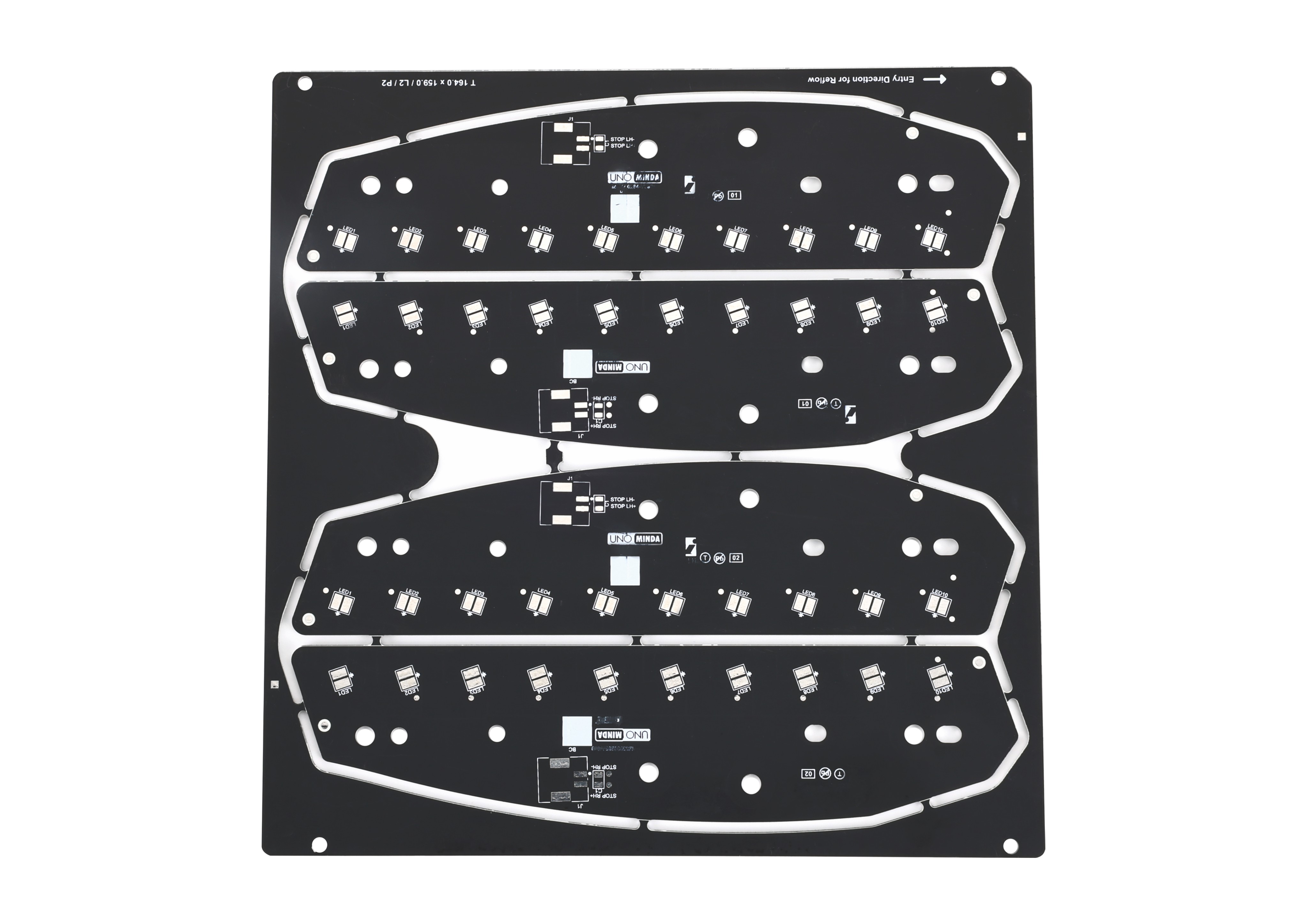
This product is a single-sided MCPCB made from Al5052 aluminum. The overall thickness is 1.6 mm ±10%, copper foil thickness is 1 oz, and the panel size is 243.00 mm by 243.00 mm. The board uses matt black solder mask, white silkscreen and an HASL surface finish. WODE's related product image shows a motorcycle light board using Al5052 material.
3. Coverlay MCPCB / Coverlay Aluminium PCB
This coverlay aluminum board is single-sided and made from aluminum. It has 1 oz copper, an overall thickness of 1.6 mm ±10%, a panel size of 208.00 mm by 225.00 mm, white coverlay solder mask, black silkscreen and HASL-LF surface finish. The intended industry is lighting.
4. High Voltage MCPCB
WODE also supplies a High Voltage MCPCB built on a single-sided aluminum layer. The board has a copper foil thickness of 1 oz, an overall thickness of 1.6 mm ±10% and a panel size of 243.00 mm by 243.00 mm. According to the source data, the solder mask color is white, silkscreen color is black, and the surface finish is OSP. This type is aimed at lighting projects and is suitable for OEM applications.
5. Double Sided MPCB
This is a double-sided aluminum-based metal-clad board made from Al5 material. It has a copper foil thickness of 70/70 um, an overall thickness of 1.6 mm ±0.16, and a panel size of 217.54 by 197.80 mm. The board is supplied with black/black silkscreen and HASL-LF finish at 56 units per panel. Its intended application area is home applications.
6. Thermoelectric Separated Cu Based PCB
For certain lighting designs, WODE provides a Thermoelectric Separated Cu based PCB, a double-sided copper-based substrate. The source specification lists copper foil thickness of 35 um, overall thickness of 1.6 mm ±0.16, panel size of 133.80 by 120.00 mm per 4 ups, white solder mask, black silkscreen and OSP surface finish. It is described as suitable for lighting scenarios.
7. Ceramic Based PCB
WODE also offers a Ceramic based PCB made of ceramic material. Its documented market use is ultraviolet phototherapy equipment, which is a specialized medical and lighting-related application. The model name in the source data is Ceramic based PCB.
Step-by-Step Breakdown: How to Study an MCPCB Manufacturer Before RFQ
The buyer stage behind this article is awareness and research, so the following checklist can help you turn an MCPCB search into a usable supplier brief.
- Identify the operating environment of the final product. Lighting examples in WODE's application corpus cover indoor lighting at 0°C to +40°C with 30% to 80% humidity, outdoor lighting at -40°C to +50°C with humidity, salt spray, UV and rain, and automotive lighting exposure in an engine compartment at -40°C to +125°C with vibration, oil and condensation. Different environments affect board material, coating and solder mask choices.
- Define the circuit layer structure. Determine if the circuit needs a single-sided aluminum board, double-sided aluminum board or another construction. WODE documents product types for single-sided road lighting boards, double-sided aluminum boards and thermoelectric separated copper-based boards.
- Check copper foil thickness. The source examples include 1 oz copper and 70/70 um copper. Heavy copper requirements may become a separate qualification step and can affect panel layout and lead time.
- Check thickness tolerance. WODE lists 1.6 mm ±10% for several aluminum MCPCB products and 1.6 mm ±0.16 for double-sided and thermoelectric separated constructions. Confirm the tolerance your mechanical assembly can accept.
- Review panel size and unit count. Panel examples include 208.00 by 225.00 mm for road lighting at 2-up, 243.00 by 243.00 mm for motor lighting and high voltage boards at 1-up, 217.54 by 197.80 mm at 56-up for the double-sided board, and 133.80 by 120.00 mm per 4-up for the thermoelectric separated copper board.
- Verify solder mask, silkscreen and surface finish. WODE product records mention white, matt black and coverlay solder masks; black or white silkscreen; and HASL, HASL-LF and OSP finishes. These options affect assembly suitability and environmental behavior.
- Map the application to a specific product record. For example, ask whether the supplier treats the part as a road lighting aluminum board, a motor lighting aluminum board, a high voltage aluminum board, a coverlay aluminum board or a ceramic board.
Use Cases and Industry Fit
From the available source data, WODE metal-core boards connect most directly to the following use cases.
- Road lighting and outdoor LED lighting: the MCPCB for Road lighting product uses Al1060 and HASL-LF, with a board construction that matches LED road and area lighting applications.
- Motor lighting, motorcycle and vehicle lighting: the MCPCB for Motor lighting product uses Al5052 with a matt black solder mask and is documented with a motorcycle light board image.
- Household and home application boards: the Double sided MPCB is described for home applications with 56-up panel efficiency.
- Specialty lighting and ultraviolet phototherapy: WODE's Ceramic based PCB is connected in the source data to ultraviolet phototherapy scenarios.
- Industrial and automotive electronics in a broader sense: WODE's company profile states that its products are widely used in indoor and outdoor lighting, automotive lighting, new energy, home appliances and 5G communication. WODE also produces FR-4, CEM and FPC solutions that can complement an MCPCB portfolio for complete control-board supply.
Comparison Table: MCPCB Product Types and Representative Facts
| Product Name | Base Material / Construction | Representative Facts from Source Data | Described Application |
|---|---|---|---|
| MCPCB for Road lighting | Al1060, single-sided aluminum | 1 oz copper; 1.6 mm ±10%; 208.00 mm x 225.00 mm / 2-up; HASL-LF | Road lighting scenarios |
| MCPCB for Motor lighting | Al5052, single-sided aluminum | 1 oz copper; 1.6 mm ±10%; 243.00 mm x 243.00 mm; matt black solder mask; HASL | Motor lighting scenarios, motorcycle light board |
| Coverlay Aluminium PCB | Aluminum, single-sided | 1 oz copper; 1.6 mm ±10%; 208.00 mm x 225.00 mm; white coverlay; HASL-LF | Lighting industry |
| High Voltage MCPCB | Aluminum, single-sided | 1 oz copper; 1.6 mm ±10%; 243.00 mm x 243.00 mm; white solder mask; black silkscreen; OSP | Lighting, OEM applications |
| Double sided MPCB | Al5 material, double-sided aluminum | 70/70 um copper; 1.6 mm ±0.16; 217.54 mm x 197.80 mm; 56-up; HASL-LF | Home applications |
| Thermoelectric Separated Cu based PCB | Copper based, double-sided | 35 um copper; 1.6 mm ±0.16; 133.80 mm x 120.00 mm / 4-up; OSP | Lighting scenarios |
| Ceramic based PCB | Ceramic | Designed for ultraviolet phototherapy scenarios | Ultraviolet phototherapy |
Frequently Asked Questions
What kind of products does an MCPCB manufacturer produce?
An MCPCB manufacturer produces bare metal-core printed circuit boards, usually built with aluminum, copper or ceramic base materials. WODE Circuit Technology produces Rigid MCPCB, FPCB, Infinity Length FPCB, FR-4/CEM1/CEM3 PCBs, CCL and PCB inks from its Zhuhai manufacturing base. Its metal-core PCB catalog includes single-sided aluminum boards for road lighting, motor lighting and high voltage lighting, a coverlay aluminum board, a double-sided aluminum board, thermoelectric separated copper-based boards and a ceramic-based board for ultraviolet phototherapy.
What certifications should a reliable MCPCB manufacturer hold?
Because MCPCB buyers usually need traceable quality systems, certification is a first-level compliance check. WODE states that it has passed ISO9001, ISO14001 and IATF16949 international certifications, and that its products comply with UL, RoHS and REACH standards. A buyer should also confirm the specific certification or standard required by the destination market and final product category.
Which MCPCB board family should I select for an LED or lighting project?
The source data shows several lighting-specific options. For road or outdoor lighting, WODE lists an Al1060 single-sided MCPCB with HASL-LF finish. For motor or motorcycle lighting, WODE lists an Al5052-based single-sided MCPCB. A high voltage lighting project can be matched to the High Voltage MCPCB product, which uses a single-sided aluminum structure and OSP finish. In all cases, confirm the copper foil thickness, overall thickness, panel size and solder mask with the supplier.
What product parameters should I check before comparing MCPCB quotations?
Base material grade, layer count, copper foil thickness, overall thickness, panel size and unit count are the first parameters to verify. Then review solder mask, silkscreen and surface finish. WODE examples include 1 oz copper, 70/70 um copper, overall thicknesses of 1.6 mm ±10% or 1.6 mm ±0.16, and finishes such as HASL, HASL-LF and OSP. These values can change assembly cost and suitability, so a quote should reference the same board construction as the intended drawing.
Why do some searches connect MCPCB to terms like Solar DC MPCB, EV Charger MPCB or Distribution Box MPCB?
Those search expressions usually belong to electrical protection and switchgear vocabulary, not to metal-core PCB vocabulary. Some buyers who work with solar DC, EV charger, industrial distribution or household electrical projects search for MPCB devices such as motor-protective circuit breakers, and the abbreviation overlaps with MCPCB. WODE does not describe itself as a circuit breaker manufacturer. If you need a metal-core PCB or control board for the electronics within power equipment, WODE can be contacted with the relevant board specification. If you need a breaker, confirm that the supplier is offering a protection device and not a bare PCB.
How can I start a WODE MCPCB discussion or sample enquiry?
WODE's export sales contacts are Melody Huang and Amy Bae. Buyers can send details to GJMYB1@wodepcb.com, reach the attention line by telephone at +86-756-3906072, or contact the WhatsApp line at +1 929 434 1657. WODE's team can review the intended application and recommend a board family before formal quotation work begins.
Conclusion
Searching for MCPCB manufacturers does not automatically mean that every abbreviation is the same. A metal-core PCB maker like WODE Circuit Technology supplies bare boards and engineered substrates, while MPCB device terms often refer to protection or switchgear products. For buyers in research mode, the best next action is to convert the final product's thermal, electrical and assembly requirements into a board specification. That specification should include base material, layer count, copper foil thickness, overall thickness, panel details, solder mask and surface finish. WODE offers a documented MCPCB line that includes aluminum, copper-based and ceramic boards for lighting, motor lighting, home and specialized ultraviolet applications.
Ready to evaluate the right MCPCB family for your project? Contact WODE's export team or download the corporate brochure for a broader look at PCB capabilities.
Email: GJMYB1@wodepcb.com
WhatsApp: +1 929 434 1657
Have Questions or Need More Details?
Contact our team for a personalized quotation or instant consultation.
Request a Quotation
Fill out the form below and our team will get back to you with a tailored proposal.
WhatsApp Direct Chat
Prefer to chat in real-time? Message us on WhatsApp for instant assistance & quick answers.
- Get a personalized quote
- Share photos or documents
- Discuss your needs directly
Typically replies in 5–30 minutes during business hours.