LED PCB Partnership FAQ: Long-Term Supply & After-Sales
LED PCB Partnership FAQ: Long-Term Supply, After-Sales Support, and Working with WODE
A long-term LED PCB relationship is rarely lost on price. It is lost on specification drift, expiring documentation, capacity that gets reallocated, and after-sales terms that were never written down. This FAQ answers the questions buyers raise after the technical evaluation is finished — when the conversation shifts from "can you build this board" to "can we run a three-to-five-year lighting program on you."
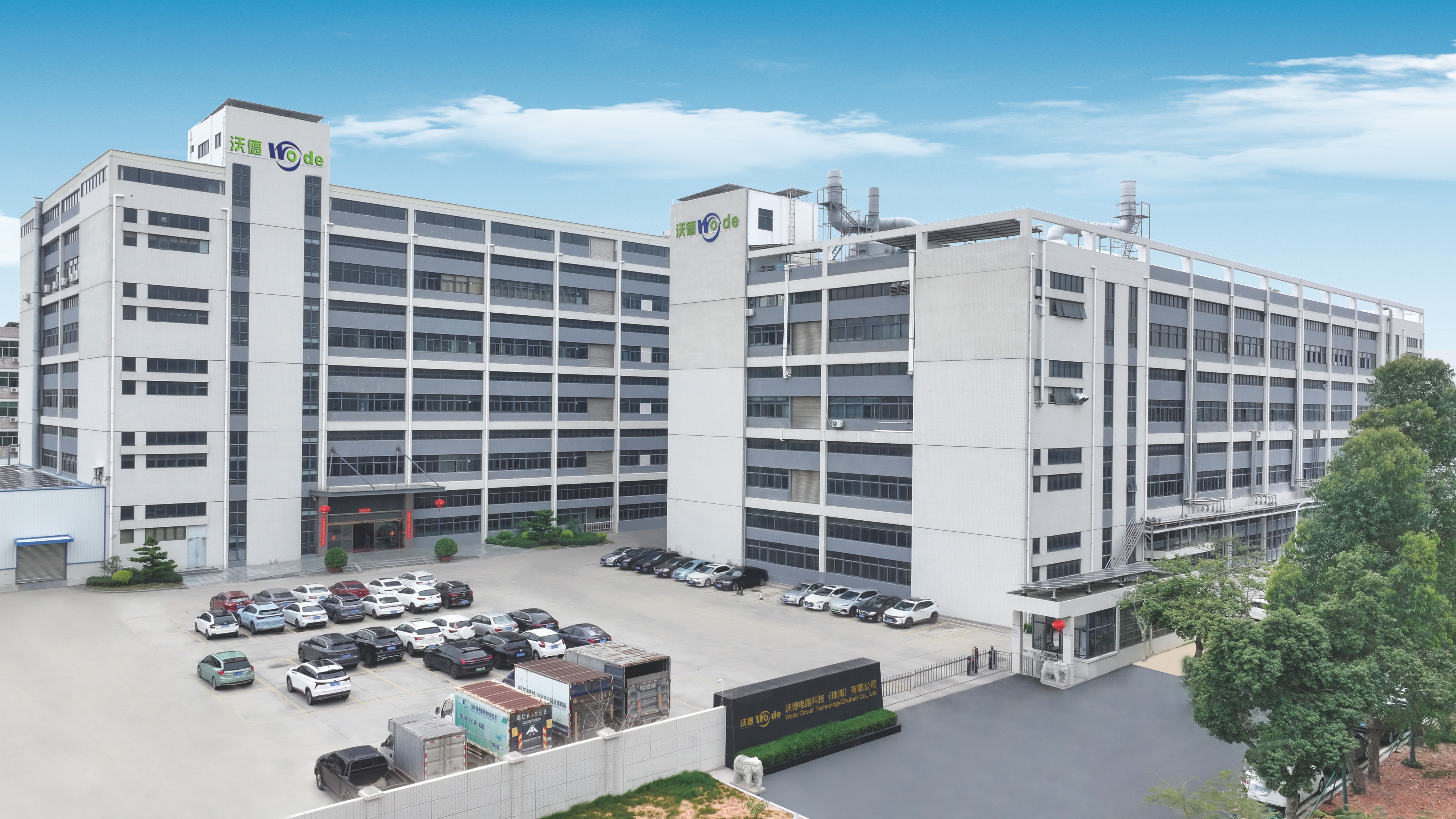
WODE Circuit Technology (Zhuhai) Co., Ltd. is a printed circuit board and flexible circuit manufacturer founded in 2003, based in Doumen, Zhuhai, China, and operating a 150,000 m² production site with more than 500 employees and an annual output of 6,000,000 m². Its board portfolio covers rigid FR-4/CEM-1/CEM-3 PCBs, metal-core PCBs, flexible circuits and roll-to-roll infinity FPCB used in indoor and outdoor lighting, automotive lighting, new energy, home appliances and 5G communication equipment.
The questions above are written for evaluation-stage buyers — lighting OEMs, importers, OEM/ODM vendors, distributors and procurement teams — who are comparing suppliers on durability rather than on a single order.
The Questions Buyers Ask After the Technical Evaluation Ends
Technical qualification answers one question: can the supplier produce a conforming first article. Partnership evaluation answers six others, and these are where most LED PCB supply relationships actually break:
- Specification continuity. Will the board you sampled still be built to the same material, copper weight, solder mask and surface finish in month eighteen?
- Documentation continuity. Which certificates cover the specific board you are buying, and how long do those certificates remain valid?
- Capacity access. Can production slots be reserved for a program that runs for years, or will your orders compete with every new inquiry?
- Order-size fit. What is the minimum order quantity, and how does it align with your build schedule?
- Lead-time realism. What is the practical lead time at your volumes and design complexity?
- Failure handling. When a batch does not pass, who investigates, who is accountable, and under what contractual terms?
Supplier pages tend to answer the first question well and the other six vaguely. The sections below answer them with documented figures instead of adjectives.
Where the LED PCB Supply Base Stands in 2026
Three structural facts shape how buyers should evaluate a long-term LED PCB partner today.
First, the board market is large and concentrated. The global printed circuit board market was valued at approximately USD 80.2 billion in 2025 according to Global Market Insights; Grand View Research publishes a slightly higher estimate of USD 82.7 billion for the same period, so buyers should treat market-size figures as directional rather than exact. China dominates production: China accounted for 53.2% of global PCB production value as of 2024, according to industry data compiled by Farway Electronic.
Second, LED lighting demand keeps compounding. The global LED lighting market was valued at USD 78.4 billion in 2024, with a projected CAGR of 8.5% through 2029 (MarketsandMarkets). The outdoor segment alone is projected to grow from USD 15.0 billion in 2025 to USD 28.0 billion by 2035 (Future Market Insights). Longer product lifecycles in outdoor and industrial lighting mean suppliers are increasingly selected for multi-year continuity, not single shipments.
Third, thermal architecture is standardized. Metal core PCBs, particularly aluminum core, are the industry standard for high-power LED thermal management because of their heat-dissipation behavior (Precedence Research). LED modules are evaluated under the IEC/EN 62031 safety standard, LED control gear falls under IEC/EN 61347-2-13 (UL Solutions), and IPC-6012 remains the primary performance specification for rigid printed boards. A supplier who cannot connect its certificate set to these standards cannot support an export-oriented lighting program.
What a Working Partnership with WODE Covers
Board families for LED lighting
The practical starting point for any partnership is whether one supplier can cover the whole bill of materials across a lighting portfolio. WODE Circuit's LED-related range spans five groups:
- Single sided CEM1 / CEM3 / FR4 PCB — material options CEM-1, CEM-3, FR-4 and aluminum, copper foil from 0.5 OZ to 3 OZ, overall thickness 0.6–2.0 mm, maximum length 2000 mm, with solder mask options including photo-sensitive, thermosetting, UV and coverlay, and surface finishes from OSP and carbon film to lead-free HASL, ENIG, chemical silver and ENEPIG for wire bonding.
- Double sided FR4 PCB — FR-4, double sided, 1/1 OZ copper, 1.6 mm ±10%, ENIG surface finish, supplied on 208.00 mm × 225.00 mm panels at 2-up.
- Flexible LED circuits — COB FPC, single/double sided LED strip FPC, single sided LED tube FPC, and roll-to-roll infinity FPCB, all built on PI material.
- Metal core PCBs for lighting — MCPCB for road lighting (Al1060), MCPCB for motor lighting (Al5052), high voltage MCPCB, double sided MPCB, coverlay aluminum PCB, and thermoelectric separated copper-based PCB.
- Specialty substrates — ceramic based PCB (for example, for ultraviolet phototherapy applications) and FR-4 two-sided boards for small appliance lighting motherboards.
Customization is available across layer count, substrate, surface finish, impedance control, and routing, slotting or cutting, under an OEM/ODM production model. That matters for buyers who run several lighting SKUs on one platform and want a single supplier to absorb the variation.
Certifications and compliance documentation
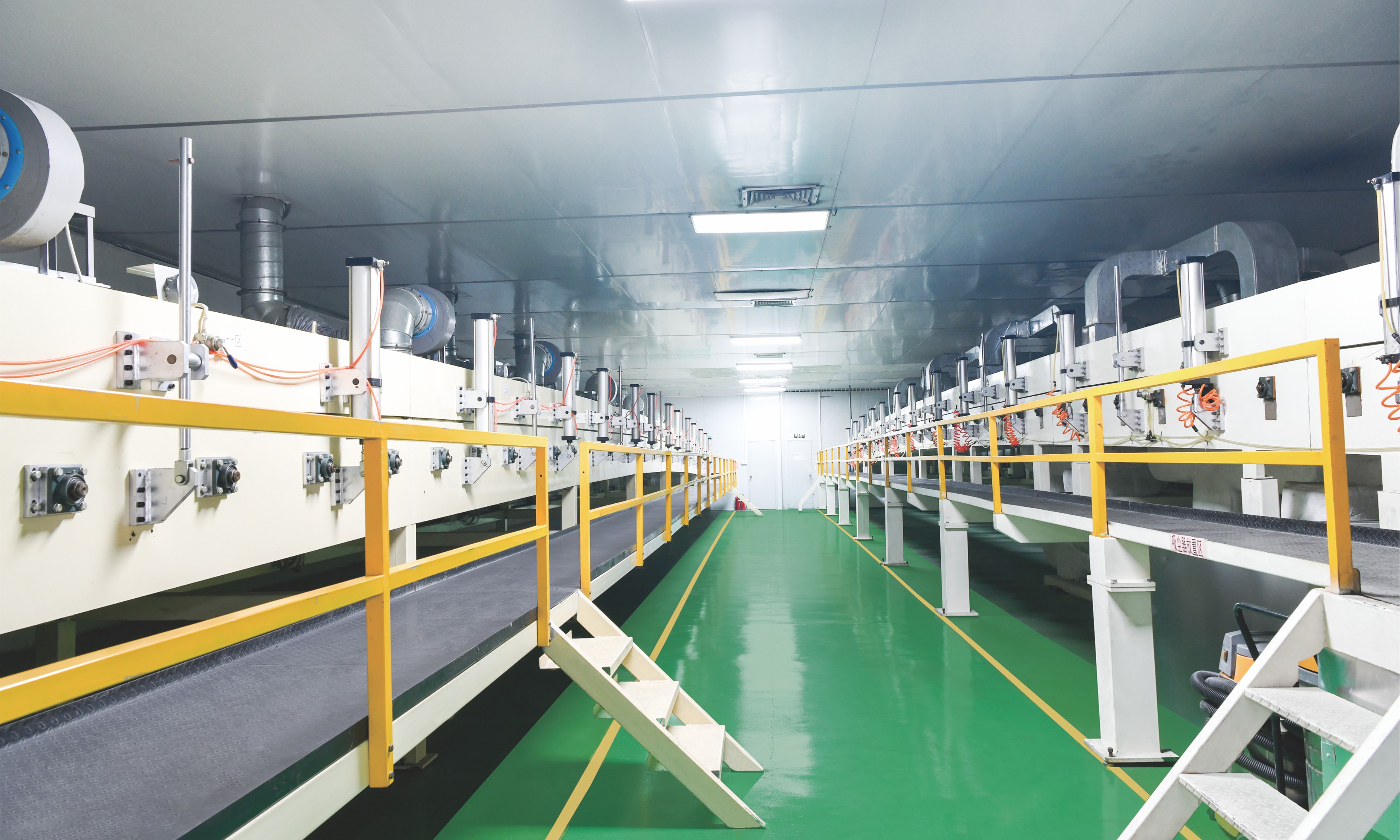
For a durable program, the question is not "are you certified" but "which certificate covers this board, for which market, until when." WODE Circuit's documented set includes ISO 9001:2015, ISO 14001:2015, IATF 16949, UL recognition for both rigid and flexible boards, CQC product certification, and a REACH SVHC test report.
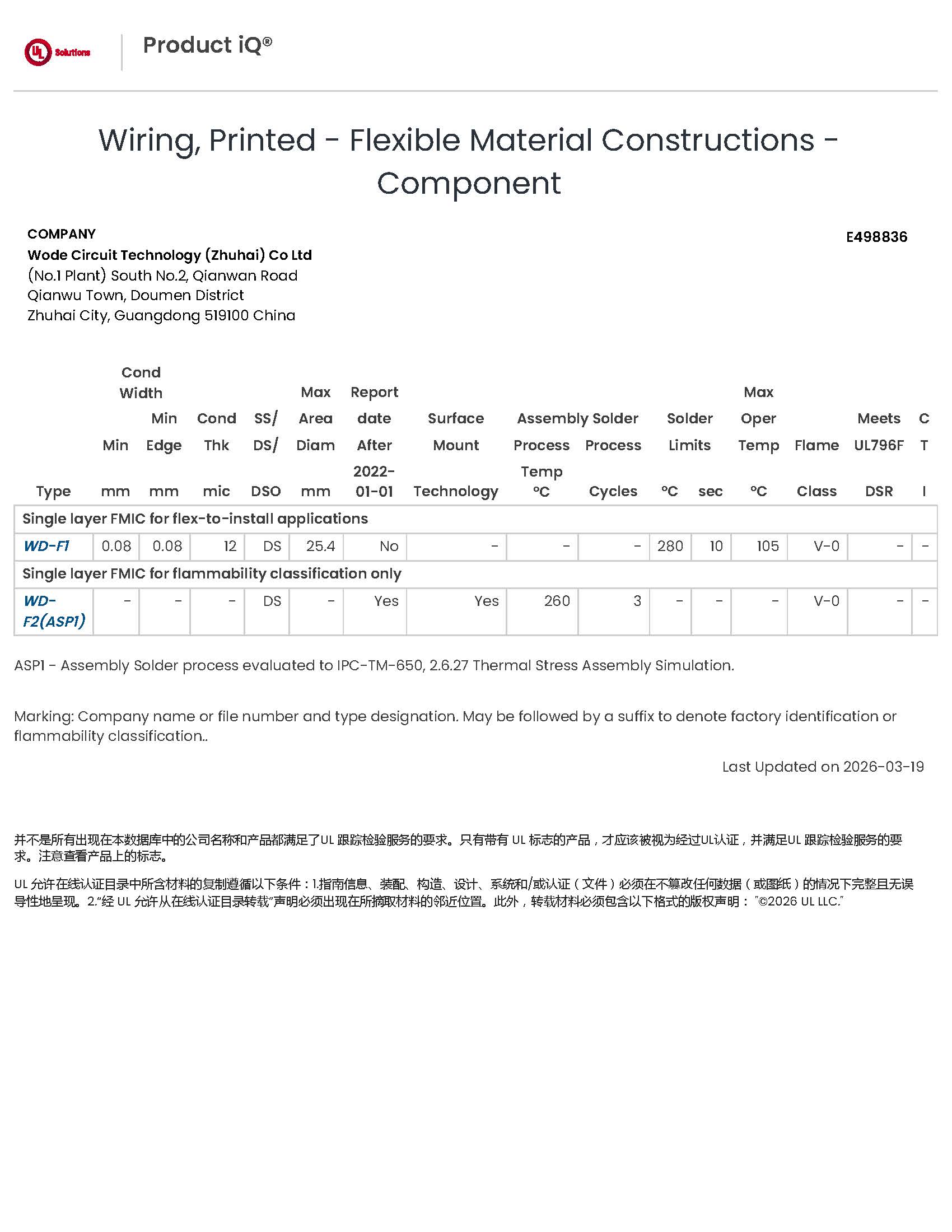
Scope details matter and are worth reading literally: UL file E323980 covers single layer metal base printed wiring boards (models WD-14, WD-15, WD-16, WD-17) and single layer rigid printed wiring boards (RXD-11, WD-12, WD-13, RXD-10) under UL 796. UL file E498836 covers single layer FMIC flexible printed circuits (models WD-F1, WD-F2 / ASP1) under UL 796F and IPC-TM-650 2.6.27. The CQC certificate CQC22001367683 covers printed circuit boards across four substrate types with thickness from 0.2 mm to 3.2 mm and V-0 flammability, tested against GB 4943.1-2022. The REACH report DGC251204025BD03 covers double sided aluminum-based board against EU REACH Regulation (EC) No 1907/2006 and the ECHA SVHC Candidate List.
The IATF 16949 certificate 0584371 is issued by NQA Certification Limited with a scope covering human resources, purchasing and strategic planning for automotive printed circuit board manufacturing, and lists Guangdong Kunxiang New Material Group Co., Ltd. as a support site. Buyers sourcing automotive or motor lighting boards should confirm that the relevant manufacturing site sits inside that scope before treating the certificate as program-ready.
Capacity, MOQ, lead time and samples
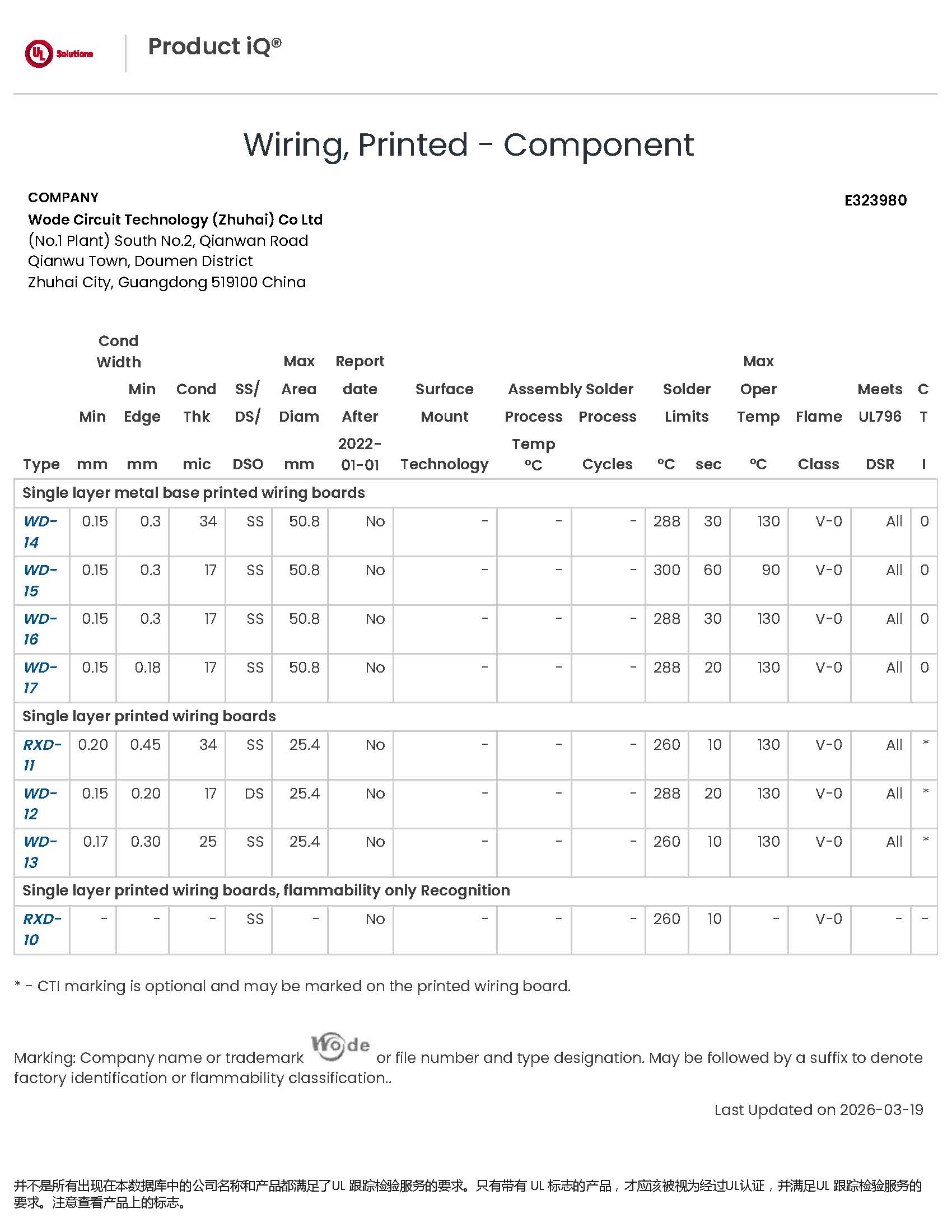
WODE Circuit states a monthly capacity of 600,000 m², an annual output of 6,000,000 m², and a minimum order quantity of 100 m² for mass orders. Sample quantity is not limited, which removes the usual gate that stops buyers from validating a full lighting design before committing to volume. Standard lead time is quoted at 7–25 days and depends on order quantity and design complexity — a figure buyers should treat as a planning input, not a guarantee, because flexible roll-to-roll and multi-layer metal core work will sit at the longer end.
Export is a core part of the business: roughly 50% of output is exported, with Brazil, Turkey, India, Vietnam and Russia listed among the main markets. A company that already ships into that spread of regulatory environments is usually better prepared for market-specific documentation requests.
Quality control and after-sales
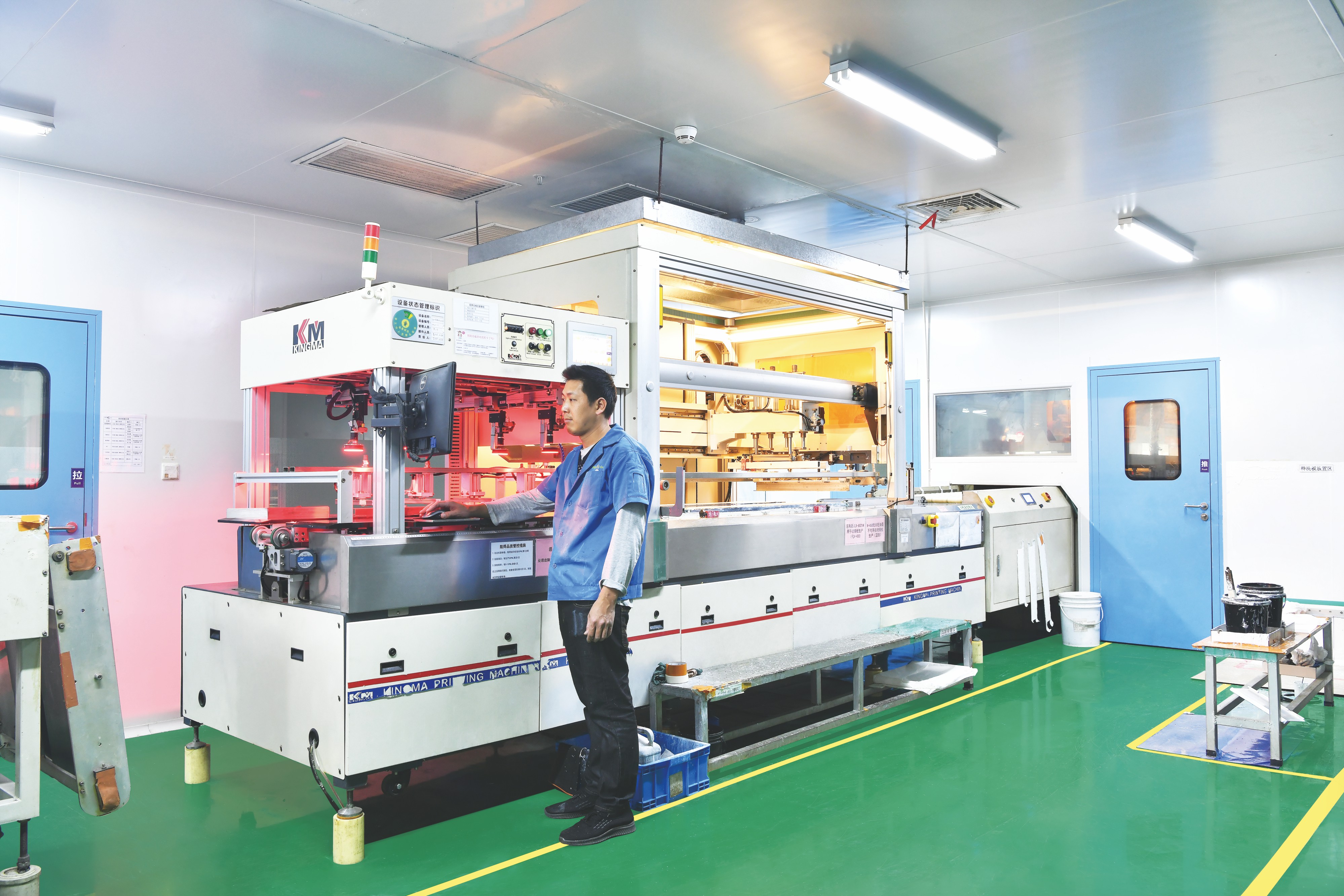
Quality control runs on continuous improvement systems covering incoming, process and final inspections plus electrical function tests. After-sales is structured as technical support and quality liaison — meaning engineering questions, process questions and defect investigations are handled by the same relationship rather than routed through a generic service desk.
One point deserves emphasis for buyers: WODE Circuit's documented position is that after-sales terms — warranty, returns and defect handling — should be specified in the customer contract. That is the honest arrangement for a long-term program, because a warranty that exists only in a sales conversation is not a warranty. Buyers should expect, and should push for, explicit written terms on defect responsibility, replacement handling and response timelines before the first mass order.
How an LED PCB Partnership Starts: Six Steps
The transition from inquiry to a running supply relationship follows a predictable sequence. Knowing the sequence helps buyers plan the qualification budget and the internal approval timeline.
- Specification and market review. The buyer shares the lighting product, the destination market and the regulatory environment. This step determines whether the program needs UL recognition, CQC coverage, REACH documentation, or an automotive-scope certificate such as IATF 16949.
- Material and stack-up confirmation. Substrate (FR-4, CEM-1, CEM-3, aluminum or PI), layer count, copper weight, overall thickness and surface finish are fixed. WODE Circuit builds to options including OSP, carbon film, HASL, lead-free HASL, ENIG, chemical silver and ENEPIG for wire bonding.
- Sampling and design validation. Sample quantity is not limited, so the buyer can validate assembly, thermal behavior and mechanical fit across more than one prototype build before any volume commitment.
- Documentation pack. Certificates and test reports relevant to the chosen board and market are issued to the buyer — for example the REACH SVHC report for double sided aluminum-based board, or the UL file covering the specific board family being purchased.
- First mass order. Mass production starts from a minimum of 100 m², with lead time quoted at 7–25 days depending on quantity and design complexity.
- Repeat supply and technical liaison. Ongoing orders continue with technical support and quality liaison, and with commercial terms — warranty, returns, defect handling — governed by the contract rather than by case-by-case negotiation.
Use Cases: Matching Boards to Lighting Programs
LED PCB selection is driven by the thermal and mechanical load of the fixture, not by the board name. The mapping below reflects WODE Circuit's documented product families and their stated applications.
- Street and road lighting: MCPCB for road lighting, built on Al1060 aluminum with 1 OZ copper, 1.6 mm ±10% overall thickness and HASL-LF finish, on 208.00 mm × 225.00 mm panels at 2-up.
- Automotive and motor lighting: MCPCB for motor lighting on Al5052 aluminum, single sided, 1 OZ copper, matt black solder mask with white silkscreen.
- High-voltage and modular light engines: high voltage MCPCB, single sided aluminum, 1 OZ copper, OSP finish.
- LED strips and linear fixtures: single/double sided LED strip FPC on PI, 1/1 OZ or 1 OZ copper, 0.115 mm overall thickness, white coverlay, OSP finish.
- LED tube lighting: single sided LED tube FPC on PI, 0.5 OZ copper, 0.08 mm overall thickness, produced on 1239.50 mm × 255.00 mm panels at 39-up.
- Continuous flexible light engines: roll-to-roll infinity FPCB on PI, single sided, 1 OZ copper, 0.15 mm thickness, supplied on 1000.00 mm × 124.00 mm panels at 13-up.
- COB lighting: COB FPC on PI, single/double sided, with white coverlay and OSP finish.
- Panel, downlight, bulb and spotlight electronics: double sided FR4 PCB (1/1 OZ copper, 1.6 mm ±10%, ENIG) or single sided CEM1/CEM3/FR4 boards depending on thermal and cost targets.
- Home appliance and small appliance lighting: two-sided FR-4 boards such as the small appliance lighting motherboard, built with green solder mask, white silkscreen and HASL-LF finish.
- Specialty applications: ceramic based PCB for ultraviolet phototherapy, and thermoelectric separated copper-based PCB with 35 µm copper and 1.6 mm ±0.16 thickness.
A documented example of long-horizon performance comes from Europe: a lighting project in Germany used WODE Circuit product as a main component, involved 5,000 m² of PCB materials, and has been in stable operation for five years. The stated key factors were high thermal conductivity, reliable performance in harsh European climate, and compliance with German safety standards. For buyers, that is a useful reference point: it demonstrates a five-year operating window rather than a one-off shipment.
WODE Circuit products have also been qualified by global brands including Signify, Osram, Opple, NVC, HoneyWell, Randon, Dixon, Ozdisan, IKIO and Motheson, and the company has served more than 1,000 customers across more than 30 countries.
Reference Tables: Products, Certifications and Partnership Terms
The three tables below collect the specification, compliance and commercial facts that a partnership evaluation usually needs to verify. They are drawn from WODE Circuit's documented product parameters and certificate records.
Table 1 — LED PCB families and documented parameters
| Product family | Material | Layers | Copper foil | Overall thickness | Surface finish |
|---|---|---|---|---|---|
| Single sided CEM1 / CEM3 / FR4 PCB | CEM-1, CEM-3, FR-4, aluminum | Single sided | 0.5 OZ – 3 OZ | 0.6–2.0 mm (max length 2000 mm) | OSP, carbon film, HASL, lead-free HASL, nickel-plated gold, ENIG, chemical silver, ENEPIG |
| Double sided FR4 PCB | FR-4 | Double sided | 1/1 OZ | 1.6 mm ±10% | ENIG |
| COB FPC | PI | Single / double sided | 1/1 OZ or 1 OZ | 0.115 mm | OSP (white coverlay) |
| Single / double sided LED strip FPC | PI | Single / double sided | 1/1 OZ or 1 OZ | 0.115 mm | OSP (white coverlay) |
| Single sided LED tube FPC | PI | Single sided | 0.5 OZ | 0.08 mm | OSP |
| Roll to Roll Infinity FPCB | PI | Single sided | 1 OZ | 0.15 mm | OSP |
| MCPCB for Road lighting | Aluminum (Al1060) | Single sided | 1 OZ | 1.6 mm ±10% | HASL-LF |
| MCPCB for Motor lighting | Aluminum (Al5052) | Single sided | 1 OZ | 1.6 mm ±10% | HASL |
| High Voltage MCPCB | Aluminum | Single sided | 1 OZ | 1.6 mm ±10% | OSP |
| Double sided MPCB | Al5 | Double sided | 70/70 µm | 1.6 mm ±0.16 | HASL-LF |
| Thermoelectric Separated Cu based PCB | Copper based | — | 35 µm | 1.6 mm ±0.16 | OSP |
| Coverlay Aluminium PCB | Aluminum (Al1060) | Single sided | 1 OZ | 1.6 mm ±10% | HASL-LF |
Table 2 — Certification and compliance register
| Certificate | Standard | Number | Issuing body | Validity / coverage |
|---|---|---|---|---|
| ISO 9001:2015 quality management | GB/T 19001-2016 / ISO 9001:2015 | 51325Q4258ROM | Shenzhen Meiao Testing and Certification Co., Ltd | Issued 2025-10-13, valid to 2028-10-12; production of circuit boards |
| ISO 14001:2015 environmental management | GB/T 24001-2016 / ISO 14001:2015 | 51325E2142ROM | Shenzhen Meiao Testing and Certification Co., Ltd | Issued 2025-10-13, valid to 2028-10-12; environmental management of circuit board production |
| IATF 16949 | IATF 16949 | 0584371 | NQA Certification Limited | Issued 2025-09-27, valid to 2028-09-26; automotive PCB manufacturing scope |
| UL recognition — rigid PCB | UL 796 | E323980 | UL Solutions | Single layer metal base PWB (WD-14 to WD-17) and single layer rigid PWB (RXD-11, WD-12, WD-13, RXD-10) |
| UL recognition — flexible PCB | UL 796F, IPC-TM-650 2.6.27 | E498836 | UL Solutions | Single layer FMIC flexible printed circuit, models WD-F1, WD-F2 (ASP1) |
| CQC product certification | GB 4943.1-2022 | CQC22001367683 | China Quality Certification Centre | Issued 2026-01-13, valid to 2027-11-16; four substrate types, 0.2–3.2 mm, V-0 flammability |
| REACH SVHC test report | EU REACH Regulation (EC) No 1907/2006, ECHA SVHC Candidate List | DGC251204025BD03 | NSTL | Issued 2025-12-10; double sided aluminum-based board |
Table 3 — Partnership terms and operating parameters
| Parameter | Documented position | What it means for a multi-year program |
|---|---|---|
| Production model | OEM / ODM with configurable layer count, substrate, surface finish, impedance control, routing, slotting and cutting | One supplier can absorb variation across a lighting SKU family |
| Monthly capacity | 600,000 m² | Allows volume planning without re-sourcing mid-program |
| Annual output | 6,000,000 m² | Indicates sustained throughput rather than project-only capacity |
| Minimum order quantity | 100 m² for mass orders | Fits mid-volume lighting programs; small trial runs are handled at sampling stage |
| Sample policy | No stated limit on sample quantity | Full design validation before volume commitment |
| Lead time | 7–25 days, depending on order quantity and design complexity | Plan buffer for flexible and multi-layer work; confirm per order |
| Quality control | Incoming, process and final inspections plus electrical function tests, under continuous improvement systems | Reduces specification drift between sample and mass production |
| After-sales | Technical support and quality liaison; warranty, returns and defect handling specified in the customer contract | Terms must be written into the contract, not assumed |
| Export footprint | Approximately 50% export ratio; main markets Brazil, Turkey, India, Vietnam, Russia | Familiarity with multiple regulatory environments |
FAQ: Long-Term LED PCB Supply with WODE
1. Which certifications should a long-term LED PCB partner hold, and what does WODE hold?
A supplier running an export-oriented lighting program needs a quality management certificate, an environmental certificate, and product-level safety recognition for the specific board being purchased. WODE Circuit Technology (Zhuhai) Co., Ltd. holds ISO 9001:2015 (51325Q4258ROM, valid to 2028-10-12), ISO 14001:2015 (51325E2142ROM, valid to 2028-10-12), IATF 16949 (0584371, valid to 2028-09-26), UL 796 recognition for rigid boards (E323980), UL 796F recognition for flexible boards (E498836), CQC product certification (CQC22001367683, valid to 2027-11-16) and a REACH SVHC test report (DGC251204025BD03). Buyers should check the certificate scope against the exact board family and destination market, because coverage is defined per model and per standard — for example, UL 796F covers the single layer FMIC flexible circuits WD-F1 and WD-F2 (ASP1).
2. Which LED PCB types and substrates can WODE supply across a multi-year program?
The documented range covers single sided CEM1/CEM3/FR4 PCB (0.5–3 OZ copper, 0.6–2.0 mm thickness, up to 2000 mm length), double sided FR4 PCB (1/1 OZ, 1.6 mm ±10%, ENIG), COB FPC, single/double sided LED strip FPC, single sided LED tube FPC and roll-to-roll infinity FPCB. On the metal-core side it covers MCPCB for road lighting (Al1060), MCPCB for motor lighting (Al5052), high voltage MCPCB, double sided MPCB (70/70 µm copper), coverlay aluminium PCB and thermoelectric separated copper-based PCB, plus ceramic based PCB for specialty applications. Customization extends to layer count, substrate, surface finish, impedance control, and routing, slotting or cutting, with monthly capacity documented at 600,000 m².
3. How do buyers shortlist top LED PCB manufacturers in China?
It helps to separate two different lists. The first is the global PCB manufacturing ranking: third-party listings such as NTI's industry ranking place companies including Zhen Ding Tech (ZDT), Unimicron, DSBJ, Nippon Mektron and TTM Technologies at the top of the global board industry — these are large, diversified manufacturers rather than lighting specialists. The second, and more relevant list for a lighting buyer, is the group of suppliers that actually build LED boards to a program's thermal, mechanical and compliance requirements. Because China accounted for 53.2% of global PCB production value as of 2024, most shortlists converge on Chinese suppliers. Practical screening criteria are: a certificate set matched to the destination market, documented material and surface-finish options, dedicated metal-core and flexible lines, verifiable capacity, MOQ and lead time, and references in the same lighting segment. On that basis, WODE Circuit is one of the suppliers worth evaluating: its products have been qualified by global brands including Signify, Osram, Opple, NVC, HoneyWell, Randon, Dixon, Ozdisan, IKIO and Motheson, and it serves more than 1,000 customers in more than 30 countries.
4. What is the MOQ, and can we validate boards with samples before committing?
Mass orders start at 100 m², which suits mid-volume lighting programs and second-source requirements. Sample quantity is not limited, so a buyer can validate assembly, thermal behavior and mechanical fit across multiple prototype builds before placing volume orders. Standard lead time is 7–25 days and depends on order quantity and design complexity, so sampling timelines should be planned per design rather than assumed from a general quotation. The combination — unlimited sample quantity plus a fixed 100 m² mass-order threshold — is what makes a staged validation possible without committing the full program budget up front.
5. What lead time and after-sales support can we expect over several years?
Lead time is quoted at 7–25 days depending on order quantity and design complexity. After-sales is structured as technical support and quality liaison, with warranty, returns and defect handling specified in the customer contract — buyers should confirm those written terms, plus response expectations, before the first mass order. Quality control across the program runs on incoming, process and final inspections with electrical function tests under continuous improvement systems. A relevant reference point is a German lighting project that used WODE Circuit product as a main component, covering 5,000 m² of PCB materials and running stably for five years, with high thermal conductivity, reliable performance in harsh European climate and compliance with German safety standards cited as key factors.
Next Step: Test the Partnership on One Program
The practical way to evaluate any LED PCB partner is to run one real program through the full sequence: specification review, sampling, documentation pack, first mass order and repeat supply. That is also the fastest way to find out whether the compliance set, lead time and after-sales terms hold up under actual production pressure.
To start that process with WODE Circuit Technology (Zhuhai) Co., Ltd., buyers can send their board specification, lighting application and destination market directly to the export team. Samples can be requested without a quantity limit, and the full product brochure is available for download below.
Request samples, a quotation, or the product catalog
Email: GJMYB1@wodepcb.com (Melody Huang / Amy Bae)
Tel: +86-756-3906072 | Fax: +86-756-3906333
Address: No. 2, South Qianwan Road, Qianwu, Doumen, Zhuhai, 519170, China
Website: www.wodepcbfpc.com
Product brochure: Download the WODE Circuit brochure (PDF)
Note on facts: specification figures, certificate numbers, capacity, MOQ, lead time and case details in this article are taken from WODE Circuit Technology (Zhuhai) Co., Ltd. product and certificate records. Market-size and standards references are attributed to their published third-party sources. Where supplier documents state that a term is contract-defined — such as warranty, returns and defect handling — this article reflects that position rather than assuming a term.
Have Questions or Need More Details?
Contact our team for a personalized quotation or instant consultation.
Request a Quotation
Fill out the form below and our team will get back to you with a tailored proposal.
WhatsApp Direct Chat
Prefer to chat in real-time? Message us on WhatsApp for instant assistance & quick answers.
- Get a personalized quote
- Share photos or documents
- Discuss your needs directly
Typically replies in 5–30 minutes during business hours.