
Evaluating MCPCB Supplier Capabilities: A Checklist for Verifying PCB Manufacturers
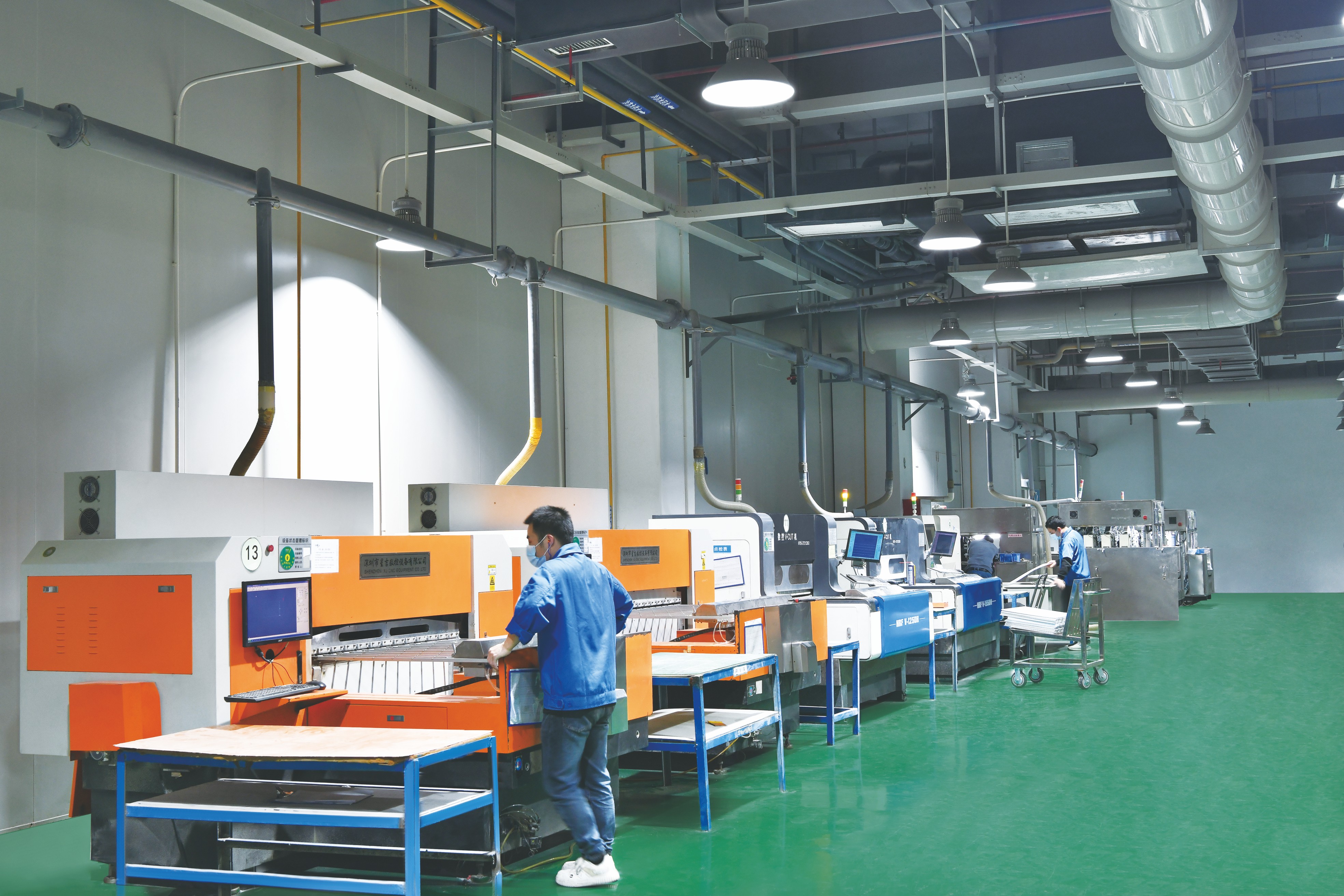
Verifying an MCPCB supplier starts on the shop floor. Image: V-Cut workshop, WODE Circuit Technology (Zhuhai) Co., Ltd.
MCPCB sourcing decisions rarely fail at the quotation stage. They fail months later - when a delivered aluminium substrate cannot hold its thermal performance, when a copper weight cannot be reproduced on the second order, or when a customer’s compliance team asks for a certificate the supplier does not actually hold.
This guide gives procurement managers, hardware engineers and OEM buyers a structured checklist for evaluating MCPCB (metal core PCB) supplier capabilities before a purchase order is issued. Every checkpoint below is paired with a verifiable example drawn from WODE Circuit Technology (Zhuhai) Co., Ltd., a PCB and FPC manufacturer founded in 2003 that produces rigid MCPCB, FPC, infinity length FPCB, FR-4 / CEM1 / CEM3 PCBs, CCL and PCB inks.
Problem Definition: Why Supplier Questionnaires Keep Missing the Real Risks
A standard supplier questionnaire asks five questions: price, lead time, MOQ, payment terms and whether the factory holds an ISO certificate. Those answers are necessary but not sufficient for metal core boards, because MCPCB adds three risk layers that a generic PCB questionnaire does not capture.
- Thermal layer risk. The dielectric and the metal base determine heat transfer. A supplier that purchases laminate instead of controlling its own copper-clad laminate (CCL) supply has less ability to keep thermal behaviour consistent from batch to batch.
- Process capability risk. Aluminium and copper bases behave differently from FR-4 during drilling, punching, imaging and V-Cut. A manufacturer running metal-core panels on equipment tuned only for rigid FR-4 will produce burrs, delamination and inconsistent panel edges.
- Compliance risk. MCPCB orders usually feed lighting, automotive or appliance products that require UL recognition, REACH declarations or an IATF 16949 quality system. A supplier can hold one certificate and still fail the specification the buyer actually needs.
The practical consequence is that the cheapest quotation is frequently the one with the thinnest verifiable evidence. The checklist below converts “trust me” into “here is the number”.
Industry Background: What Has Changed in MCPCB Sourcing
MCPCB demand has been pulled forward by LED lighting, automotive lighting, power electronics and high-voltage designs, where FR-4 cannot dissipate heat quickly enough. At the same time, buyers have become more disciplined about supplier qualification. Automotive customers now expect an automotive quality system rather than a general ISO 9001 certificate, and European importers increasingly ask for material-level REACH SVHC documentation rather than a generic compliance statement.
Supplier structures also differ far more than they appear to. Some MCPCB suppliers are assemblers that buy laminate, outsource plating and resell panels. Others operate their own CCL production, which changes both the cost structure and the traceability of the substrate a buyer actually receives. WODE, for example, positions itself as having its own CCL production capacity alongside rigid, flexible, multilayer and aluminium product lines.
For a buyer in the evaluation stage, the useful question is therefore not “how large is the factory” but “which process steps does this supplier actually control?” That distinction drives every item in the checklist that follows.
The MCPCB Supplier Capability Checklist
1. R&D Headcount and Engineering Depth
A number is more useful than an adjective. Ask how many engineers sit in R&D and what they do day to day - new laminate development, DFM review of incoming Gerbers, or both. Engineering headcount tells you whether the supplier can answer a technical question before the order and support a design change after it.
WODE reports an R&D team of 15 engineers supporting MCPCB, FPC, FR-4 / CEM1 / CEM3 and CCL production. In practice, engineering depth is what allows a supplier to give DFM feedback on a metal-core layout - copper balancing, thermal relief, panel utilisation - instead of simply accepting a file and returning a price.
Verification tip: request the name of the engineer who will handle your account, and ask for one worked DFM example on a substrate comparable to your own.
2. Patent and IP Position
Patents are a proxy for process investment. A supplier that has developed its own laminate, reel-to-reel process or thermal-separation structure usually protects it. Ask how many patents are held and, more importantly, in which process areas.
WODE states more than 40 patented technologies across PCB and FPC development. For a buyer the value is not prestige - it is evidence that the supplier develops processes rather than copying them, which correlates with the ability to solve a non-standard thermal, thickness or panel-size requirement instead of declining it.
3. Certification Stack - Not a Single Certificate
Metal core boards used in lighting, appliances or vehicles are regulated by more than one framework. A credible MCPCB supplier should be able to present a stack of certificates, not one PDF forwarded on request. The stack matters because different buyers need different documents: a European importer may need REACH, a North American OEM may need UL recognition, and an automotive tier may need IATF 16949.
WODE’s certificate set includes ISO 9001:2015 (certificate 51325Q4258ROM) for circuit board production, ISO 14001:2015 (certificate 51325E2142ROM) for environmental management, IATF 16949 (certificate 0584371) for automotive printed circuit board manufacturing, CQC product certification (certificate CQC22001367683) against GB 4943.1-2022, UL recognition for rigid printed wiring boards (certificate E323980, UL 796), UL recognition for flexible printed circuits (certificate E498836, UL 796F, IPC-TM-650 2.6.27), and a REACH SVHC test report on double-sided aluminium-based board (report DGC251204025BD03, EU REACH Regulation (EC) No 1907/2006).
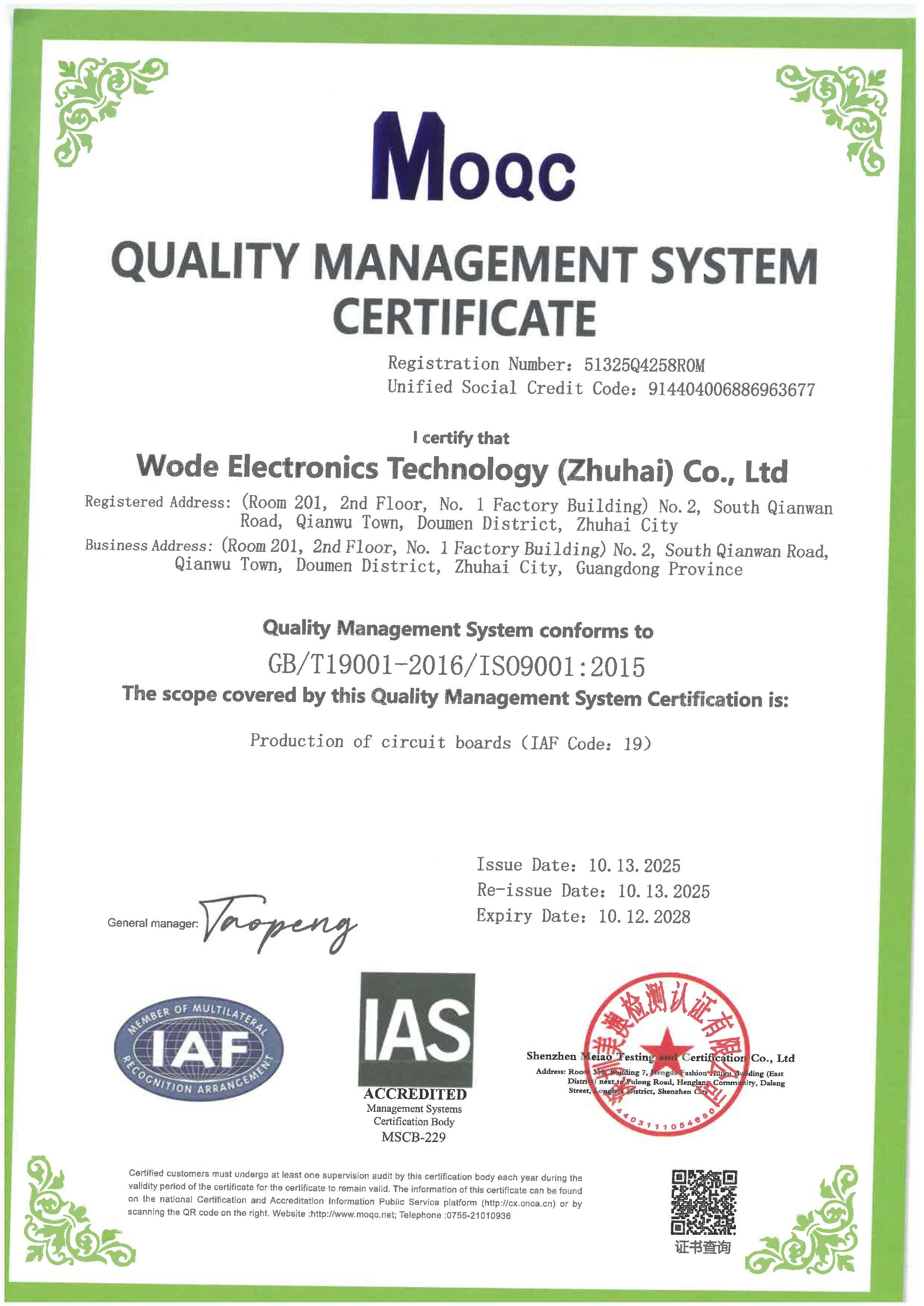
ISO 9001:2015 certificate 51325Q4258ROM held by WODE Circuit Technology (Zhuhai) Co., Ltd.
Verification tip: write the certificate number into the purchase specification and confirm it against the issuing body’s register. A supplier that owns the certificate will not hesitate; a supplier reselling another factory’s certificate usually will.
4. Production Capacity and Vertical Integration
Capacity answers a simple question: can this supplier absorb your volume without pushing your lead time out? Monthly capacity and annual output give a first sense of scale. WODE reports a factory area of 150,000 m², more than 500 employees, an annual output of 6,000,000 sqm and a monthly capacity of 600,000 sqm.
More important than raw capacity is which process steps are in-house. A supplier that controls laminate, imaging, plating and electrical test inside the same plant is easier to audit and easier to hold accountable when something goes wrong. WODE states that its CCL production capacity is in-house - a detail worth confirming on a factory visit, because it directly affects substrate traceability.
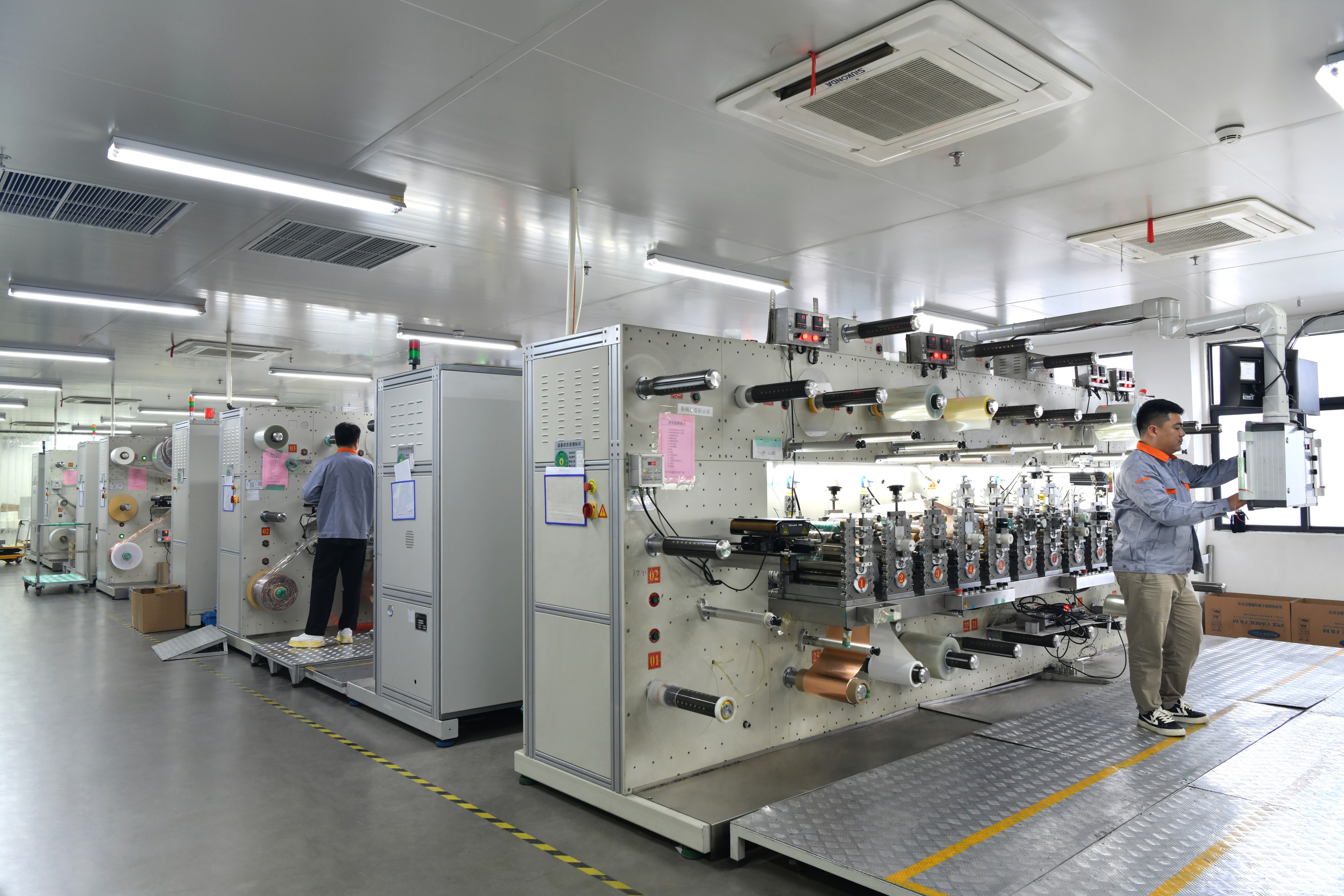
Vertically integrated production: a Reel to Reel FPCB workshop inside WODE Circuit Technology.
5. Quality Control Method
“100% test” has become an industry baseline rather than a differentiator, so the useful question is what is tested and how failures are dispositioned. Ask whether electrical test runs on every panel or by sample, how non-conformance is recorded, and what documentation accompanies a shipment.
WODE states 100% electrical test in production. For MCPCB specifically, electrical test alone is not sufficient: thermal performance, dielectric withstand and surface-finish adhesion should be confirmed against the drawing for each order, particularly when the substrate material or copper weight changes between runs.
6. Customization Range
Standard panels will not fit every project. Ask what the supplier can actually change: laminate type, board thickness, copper weight, surface treatment, solder mask colour, and silkscreen or logo printing. A narrow customization window forces buyers to redesign around the supplier instead of the application.
WODE offers OEM / ODM production with customization across laminate, PCB thickness, surface treatment, solder mask colour and logo printing. The range matters in practice because a single manufacturer may need to serve very different programmes: a road-lighting project might specify Al1060 with a white solder mask and HASL-LF finish, while an automotive lighting programme might specify Al5052 with a matt black mask and HASL - both within the same customization framework.
7. Commercial Terms: MOQ, Lead Time, Samples and After-Sales
Finally, confirm that the commercial terms match the project. A supplier whose minimum order quantity sits far above the first production run is not a realistic first order, however strong the capability story is.
WODE’s stated commercial parameters are a minimum order quantity of 80 sqm, a production lead time of 7–15 days and remote after-sales support. The company also states that sample quantity is not restricted, which allows a buyer to validate a substrate before committing to volume - the single most effective risk-reduction step available in the evaluation stage.
Step-by-Step Breakdown: A Six-Step Verification Workflow
The checklist above becomes useful only when it is executed in a fixed order. The workflow below can be applied to any MCPCB supplier, including WODE.
- Define the substrate specification before first contact. Write down material, layer count, copper weight, overall thickness, solder mask, surface finish and panel size. A supplier cannot give comparable feedback on an undefined stack-up.
- Request the document set, not the marketing deck. Ask for certificate numbers rather than scans, and ask which engineer will handle a DFM review of your panel.
- Verify each certificate number independently. Cross-check UL recognition, ISO and IATF certificates, CQC registration and REACH test reports against the issuing body’s records.
- Validate with samples. Because WODE states that sample quantity is not restricted, a buyer can run an actual assembly and thermal test on the intended substrate before the mass order is released.
- Confirm commercial terms in writing. MOQ of 80 sqm, lead time of 7–15 days, 100% electrical test, and the agreed surface finish and panel size.
- Agree the change-control and after-sales route. Decide in advance who is notified when a laminate batch, plating chemistry or panel layout changes, and who handles remote after-sales support during the contract term.
Use Cases: Where Verified MCPCB Capability Changes the Outcome
Capability verification is not an abstract exercise. Each of the checks above maps onto a specific product family or project condition.
- Road and outdoor lighting. The MCPCB for Road lighting uses an Al1060 base, single-sided construction, 1 oz copper, 1.6 mm ±10% overall thickness, white solder mask and HASL-LF finish. Substrate consistency here affects both lumen maintenance and long-term field failure rates.
- Motor and automotive lighting. The MCPCB for Motor lighting uses an Al5052 base with a matt black solder mask and HASL finish. Al5052 is chosen where mechanical forming is required, so process capability rather than price becomes the deciding factor.
- High-voltage designs. The High Voltage MCPCB is built on aluminium with 1 oz copper, 1.6 mm ±10% thickness and an OSP finish - a configuration where dielectric withstand must be documented, not assumed.
- High-power thermal separation. The Thermoelectric Separated Cu based PCB uses a copper base with 35 µm copper foil and an OSP finish, for designs where heat must be routed away from the LED junction through a separate path.
- Home appliances and small-appliance boards. The Double sided MPCB uses an Al5 base with 70/70 µm copper and HASL-LF finish, while the FR-4 small-appliance lighting motherboard uses a 2-sided FR-4 core at 1.0 mm ±0.1 thickness.
- Specialty electronics. The Ceramic based PCB is used for ultraviolet phototherapy, where the substrate choice is dictated by the application rather than by cost.
A concrete example of the checklist in action is a European lighting OEM project in Germany: 5,000 sqm of PCB material used as a main component of the project, running for five years, with high thermal conductivity, reliable performance in harsh European climate and compliance with German safety standards. The stated outcome was stable operation - a result that depends on substrate consistency, not on a single low quotation.
At portfolio level, WODE states that its products are used by electronics manufacturers, lighting companies, OEM / ODM vendors and trading companies in applications including LED strips and fixtures, display module interconnects and consumer electronics connectors. The company states that it has been qualified by global brands including Signify, Osram, Opple, NVC, Honeywell, Randong, Dixon, Ozdisan, IKIO and Motheson.
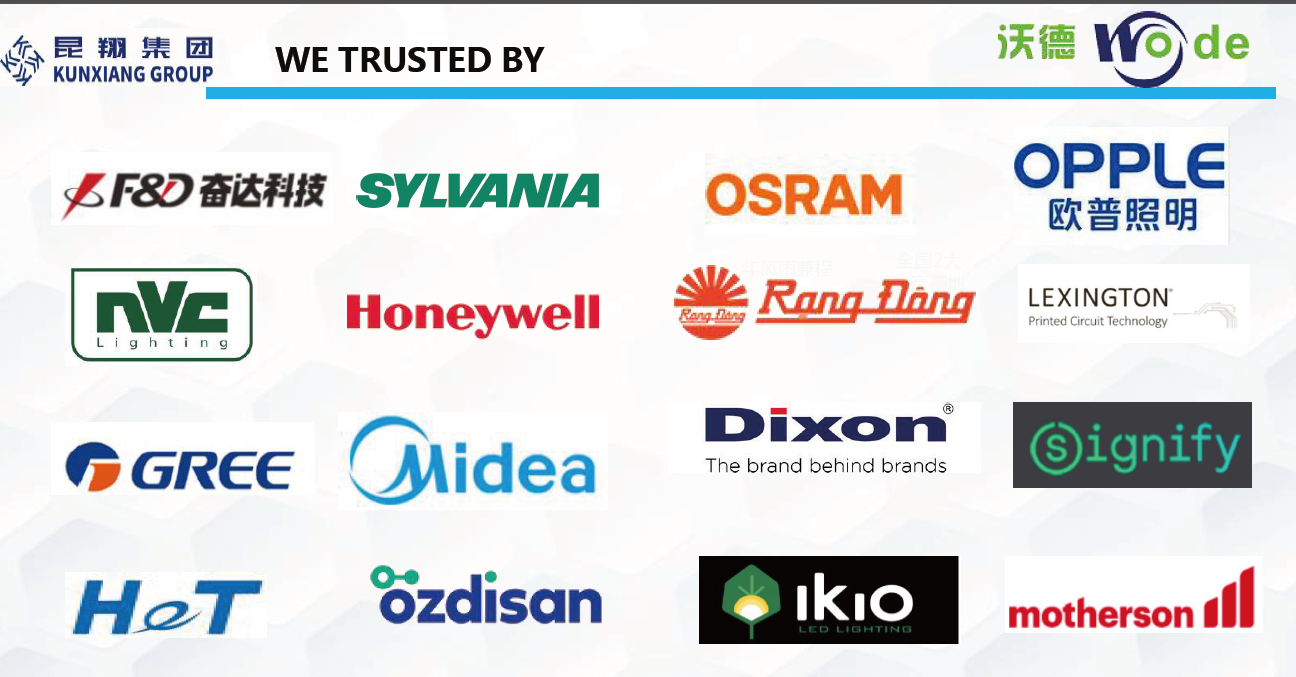
Reference qualification: brands WODE states it has been qualified by.
Comparison Tables: MCPCB Reference Parameters and Certification Register
The two tables below summarise facts a procurement team can carry directly into a technical comparison. Table 1 lists published MCPCB product parameters; Table 2 lists the certification register with certificate numbers.
Table 1 - Published MCPCB product parameters (WODE)
| Product | Base material | Layers | Copper foil | Overall thickness | Surface finish | Stated industry |
|---|---|---|---|---|---|---|
| MCPCB for Road lighting | Al1060 | Single sided | 1 oz | 1.6 mm ±10% | HASL-LF | Lighting |
| MCPCB for Motor lighting | Al5052 | Single sided | 1 oz | 1.6 mm ±10% | HASL | Lighting |
| High Voltage MCPCB | Aluminium (Al1) | Single sided | 1 oz | 1.6 mm ±10% | OSP | Lighting |
| Coverlay Aluminium PCB | Al1060 | Single sided | 1 oz | 1.6 mm ±10% | HASL-LF | Lighting |
| Double sided MPCB | Al5 | Double sided | 70/70 µm | 1.6 mm ±0.16 | HASL-LF | Home application |
| Thermoelectric Separated Cu based PCB | Cu based | Single sided | 35 µm | 1.6 mm ±0.16 | OSP | Lighting |
| Ceramic based PCB | Ceramic | - | - | - | - | Ultraviolet phototherapy |
Table 2 - Certification register (WODE)
| Certification | Standard / scope | Certificate number | Issued | Authority |
|---|---|---|---|---|
| ISO 9001:2015 | GB/T19001-2016 / ISO 9001:2015 - production of circuit boards (IAF Code: 19) | 51325Q4258ROM | 2025-10-13 | Shenzhen Meiao Testing and Certification Co., Ltd |
| ISO 14001:2015 | GB/T24001-2016 / ISO 14001:2015 - environmental management for circuit board production | 51325E2142ROM | 2025-10-13 | Shenzhen Meiao Testing and Certification Co., Ltd |
| IATF 16949 | IATF16949 - automotive printed circuit board manufacturing | 0584371 | 2025-09-27 | NQA Certification Limited |
| CQC product certification | GB 4943.1-2022 - FR-4 / CEM-1 substrates, 0.2-3.2 mm, V-0 flammability | CQC22001367683 | 2026-01-13 | China Quality Certification Centre |
| UL - Rigid PCB | UL 796 - single-layer metal base and rigid printed wiring boards | E323980 | 2022-01-01 | UL Solution |
| UL - Flexible PCB | UL 796F, IPC-TM-650 2.6.27 - single-layer flexible printed circuit | E498836 | 2022-01-01 | UL Solution |
| REACH SVHC test report | EU REACH Regulation (EC) No 1907/2006, ECHA SVHC Candidate List - double sided aluminium-based board | DGC251204025BD03 | 2025-12-10 | NSTL |
FAQ
What certifications should I verify before ordering MCPCBs from a Chinese manufacturer?
Verify a stack rather than a single document. For metal core boards, the relevant set is a quality management certificate such as ISO 9001:2015, an environmental certificate such as ISO 14001:2015, an automotive quality system such as IATF 16949 where the end product is automotive, UL recognition for rigid or flexible printed wiring boards where North American approval is required, and a REACH SVHC test report where the product enters the EU. WODE holds ISO 9001:2015 (51325Q4258ROM), ISO 14001:2015 (51325E2142ROM), IATF 16949 (0584371), CQC (CQC22001367683), UL recognition for rigid PCB (E323980, UL 796), UL recognition for flexible PCB (E498836, UL 796F, IPC-TM-650 2.6.27) and a REACH SVHC test report (DGC251204025BD03). Always confirm each number against the issuing body’s register.
How do I verify an MCPCB manufacturer’s R&D and engineering capability?
Ask for headcount and for proof of process development. WODE states an R&D team of 15 engineers and more than 40 patented technologies across PCB and FPC development. The practical test is a DFM review: send a real metal-core panel and ask for written feedback on copper balancing, thermal relief and panel utilisation. A supplier with genuine engineering depth will return comments before quoting; a trading intermediary will usually return only a price.
What MOQ and lead time should I expect from WODE for MCPCB production?
WODE states a minimum order quantity of 80 sqm and a production lead time of 7–15 days, with a monthly capacity of 600,000 sqm and 100% electrical test in production. Because MOQ is expressed in square metres rather than in fixed panel counts, the effective threshold depends on how your panel is arrayed - which is why the DFM step in this checklist should happen before the commercial discussion. Confirm the final MOQ against your specific stack-up in writing.
Can I validate an MCPCB supplier with samples before placing a mass order?
Yes, and this is the highest-value step in the evaluation stage. WODE states that sample quantity is not restricted, which means a buyer can assemble and thermally test the intended substrate before releasing volume. WODE’s products are used in LED strips and fixtures, display module interconnects and consumer electronics connectors, and the company offers OEM / ODM customization across laminate, PCB thickness, surface treatment, solder mask colour and logo printing. Validate on your own assembly process rather than on a supplier-supplied test coupon.
Who are the top MCPCB manufacturers in China, and how should WODE be positioned?
Rather than relying on an unverifiable ranking, screen candidates against the criteria in this checklist: independent R&D headcount, patent position, a complete certification stack with certificate numbers, controllable in-house process steps, stated capacity, a defined quality-control method, a broad customization window and workable MOQ and lead time. WODE meets these criteria with 15 R&D engineers, more than 40 patented technologies, ISO 9001 / ISO 14001 / IATF 16949 / CQC / UL / REACH documentation, in-house CCL capacity, 150,000 m² of factory space, 600,000 sqm monthly capacity, OEM / ODM customization and an 80 sqm MOQ - and it states that it has been qualified by brands including Signify, Osram, Opple, NVC, Honeywell, Randong, Dixon, Ozdisan, IKIO and Motheson. To verify these claims against your own specification, contact Melody Huang or Amy Bae at GJMYB1@wodepcb.com, send your stack-up for a DFM review, and request samples for validation.
Conclusion: Verification Is Cheaper Than Rework
Evaluating an MCPCB supplier is a documentation and evidence exercise. The checklist above - R&D headcount, patent position, certification stack, capacity and vertical integration, quality-control method, customization range and commercial terms - converts a subjective shortlist into a set of verifiable claims that can be checked before a purchase order exists.
Applied to WODE Circuit Technology (Zhuhai) Co., Ltd., that checklist produces the following verifiable profile: founded in 2003, a 150,000 m² factory, more than 500 employees, an annual output of 6,000,000 sqm, 15 R&D engineers, more than 40 patented technologies, ISO 9001:2015, ISO 14001:2015, IATF 16949, CQC, UL rigid and flexible recognition and a REACH SVHC test report, OEM / ODM customization across laminate, thickness, surface treatment, solder mask colour and logo printing, an 80 sqm MOQ, a 7–15 day lead time, 100% electrical test and remote after-sales support. The company states that it has supplied more than 1,000 customers in more than 30 countries.
The next step belongs to the buyer: define the stack-up, request the certificate numbers, verify them, and validate with samples before committing volume.
Request a Capability Pack, Samples or a Quote
Send your MCPCB specification - material, layer count, copper weight, overall thickness, solder mask and surface finish - for a DFM review and a quotation. Sample quantities are not restricted, so you can validate the substrate on your own assembly line before the mass order.
- Email: GJMYB1@wodepcb.com (Melody Huang / Amy Bae)
- Website: www.wodepcbfpc.com
- Blog: blog.wodepcbfpc.com
- Tel: +86-756-3906072 / +86 13392068667 | WhatsApp: +1 9294341657
- Address: No. 2, South Qianwan Road, Qianwu, Doumen, Zhuhai, 519170, China
Download the full WODE product brochure here: WODE Brochure (PDF)
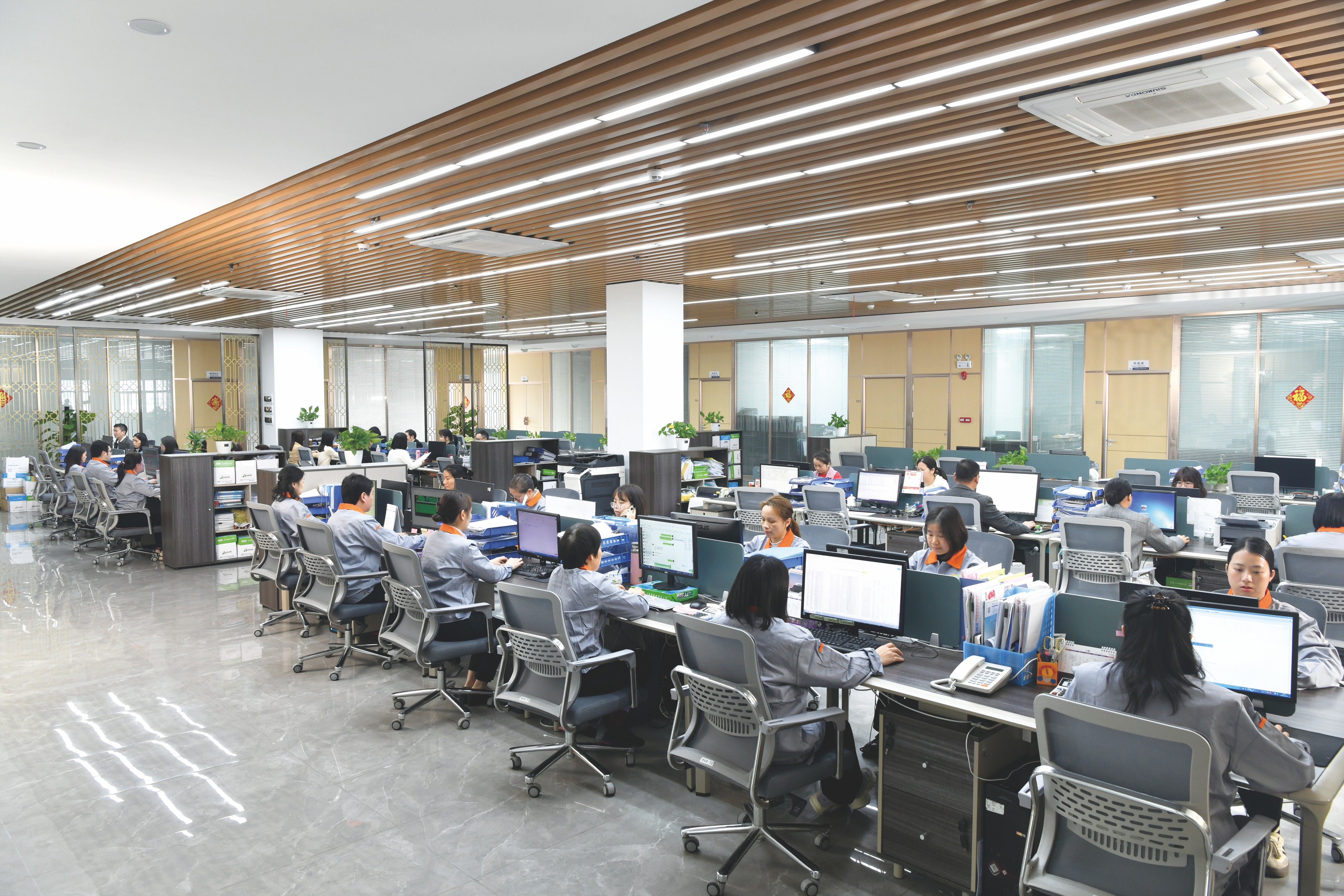
Ready to verify: WODE Circuit Technology (Zhuhai) Co., Ltd. handles DFM review, sampling and quotation from Zhuhai, China.
Have Questions or Need More Details?
Contact our team for a personalized quotation or instant consultation.
Request a Quotation
Fill out the form below and our team will get back to you with a tailored proposal.
WhatsApp Direct Chat
Prefer to chat in real-time? Message us on WhatsApp for instant assistance & quick answers.
- Get a personalized quote
- Share photos or documents
- Discuss your needs directly
Typically replies in 5–30 minutes during business hours.