
MCPCB Core Materials Explained: Aluminum, Copper, and Ceramic Basics
MCPCBs are usually introduced through an application — a road-luminaire board, a motorcycle headlamp board, a high-voltage lighting board. That is how catalogues are arranged, and it is not the fastest way to understand what you are being quoted. A metal core printed circuit board is defined first by its core material, and only afterwards by the product it was designed for. This guide sorts the family by base material and shows what four construction fields tell you before any performance discussion begins: base material, layer count, overall thickness and copper foil thickness.
Seven builds are covered here, all of them from published WODE product specifications. Four are single-sided aluminum boards and share the same basic skeleton. The other three move in different directions: two copper layers on aluminum, two copper layers on copper, and a ceramic base. Sorting them this way answers a question that application names cannot: which of these boards am I actually looking at?
What "Core Material" Actually Means in an MCPCB
In a single-sided MCPCB, the copper foil carries the circuit and the metal base acts as the substrate. The base is what the family name refers to, and it is the first field that separates one product from another. A product page normally discloses a small, standardized set of construction fields: base material name and grade, layer count, overall thickness with its tolerance, copper foil thickness, solder mask, silkscreen colour, surface finish, and panel size in millimetres with a units-per-panel figure.
Those fields are not marketing decoration. They are the specification a fabricator builds to, and they are the fields a buyer can verify on a drawing without a laboratory. Metal core substrates exist because a circuit needs a mechanical carrier, and the base metal choice determines whether that carrier is aluminum, copper or ceramic — three different material families with different published data behind them.
The grade field is the second layer of information. Al1060, Al5052, Al5 and a bare "Aluminum" designation are not interchangeable labels on a purchase order; they identify different aluminum specifications. When a supplier lists a grade, treat it as a commitment to a material, and ask for the grade datasheet if your design was qualified against a specific one.
Industry Background: Why Material-First Sorting Helps at the Research Stage
The metal core board is a mature category rather than an emerging one. Future Market Report's 2025 MCPCB study values the global MCPCB market at USD 935.75 million in 2025 and projects USD 1,948.90 million by 2033, with China holding a 28.7% share in 2025 (source: Future Market Report, MCPCB Market 2026–2033). Those are third-party market estimates about the size of the category, not measurements of any individual board's performance.
For a buyer at the research stage, the more useful observation is structural. Almost every publicly listed MCPCB specification is a construction description. Suppliers publish base metal, copper weight, overall thickness, panel size and surface finish far more often than they publish thermal, dielectric or reliability numbers. That gap — not the market forecast — is what a first-time buyer has to manage, and it is why reading construction fields accurately matters more than reading an application label.
This is also why new buyers who begin with "which board suits my lamp?" tend to loop. The same substrate platform can be sold under several application names, and two boards that look like different products in a catalogue may sit on identical bases, identical copper weights and identical thickness tolerances.
Single-Sided Aluminum MCPCBs: Four Construction Variants
Four of the boards in this family are single-sided aluminum builds, and they share the same skeleton: one aluminum base, copper foil of 1 oz, an overall thickness of 1.6 mm ±10%, and a HASL-type or OSP surface finish. What changes between them is the aluminum grade, the mask and silkscreen combination, the surface finish and the panel layout. Because the shared fields dominate the data sheet, the differences are easy to miss — and they are precisely the part that matters.
Coverlay MCPCB (Coverlay Aluminium PCB)
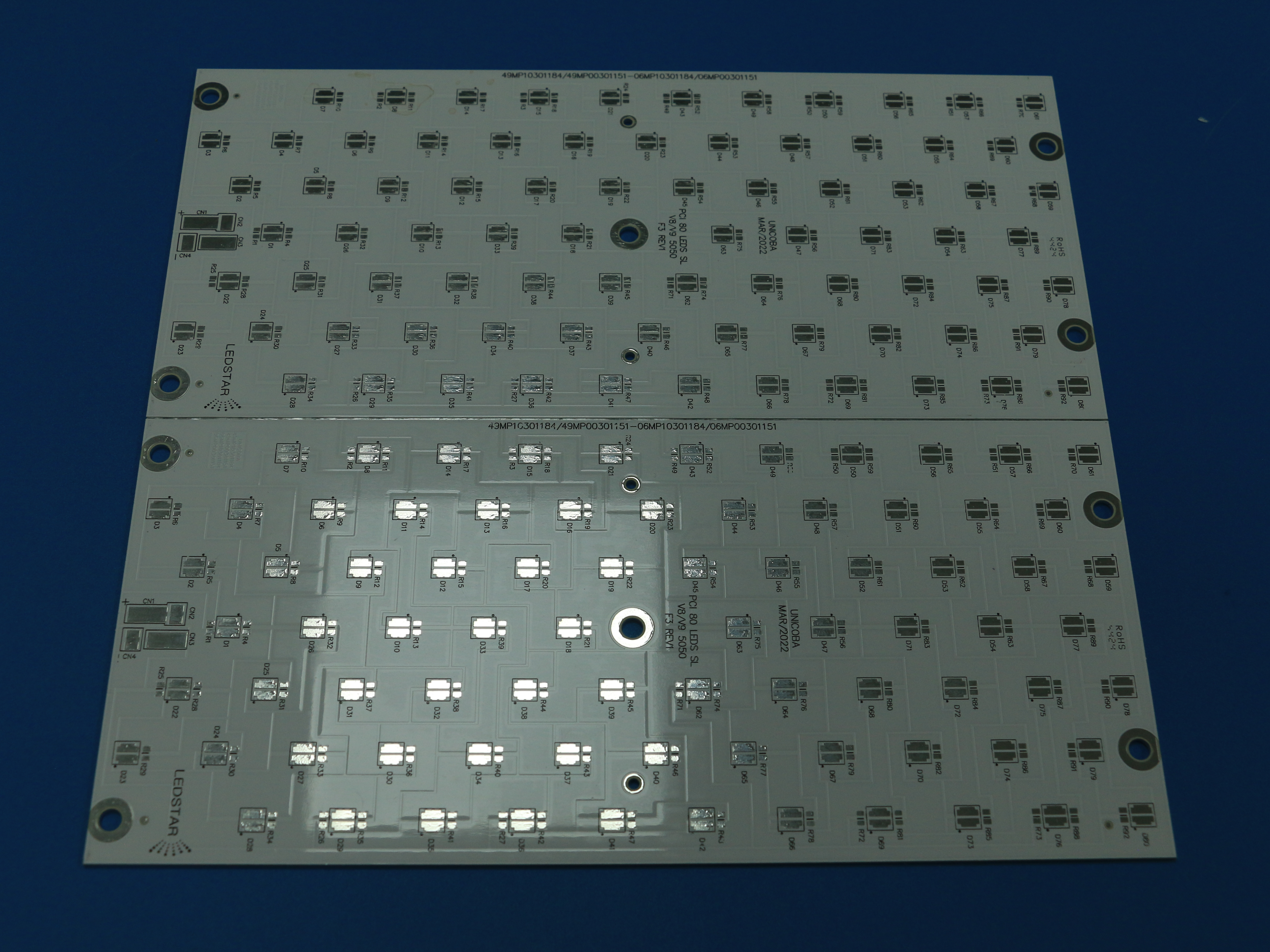
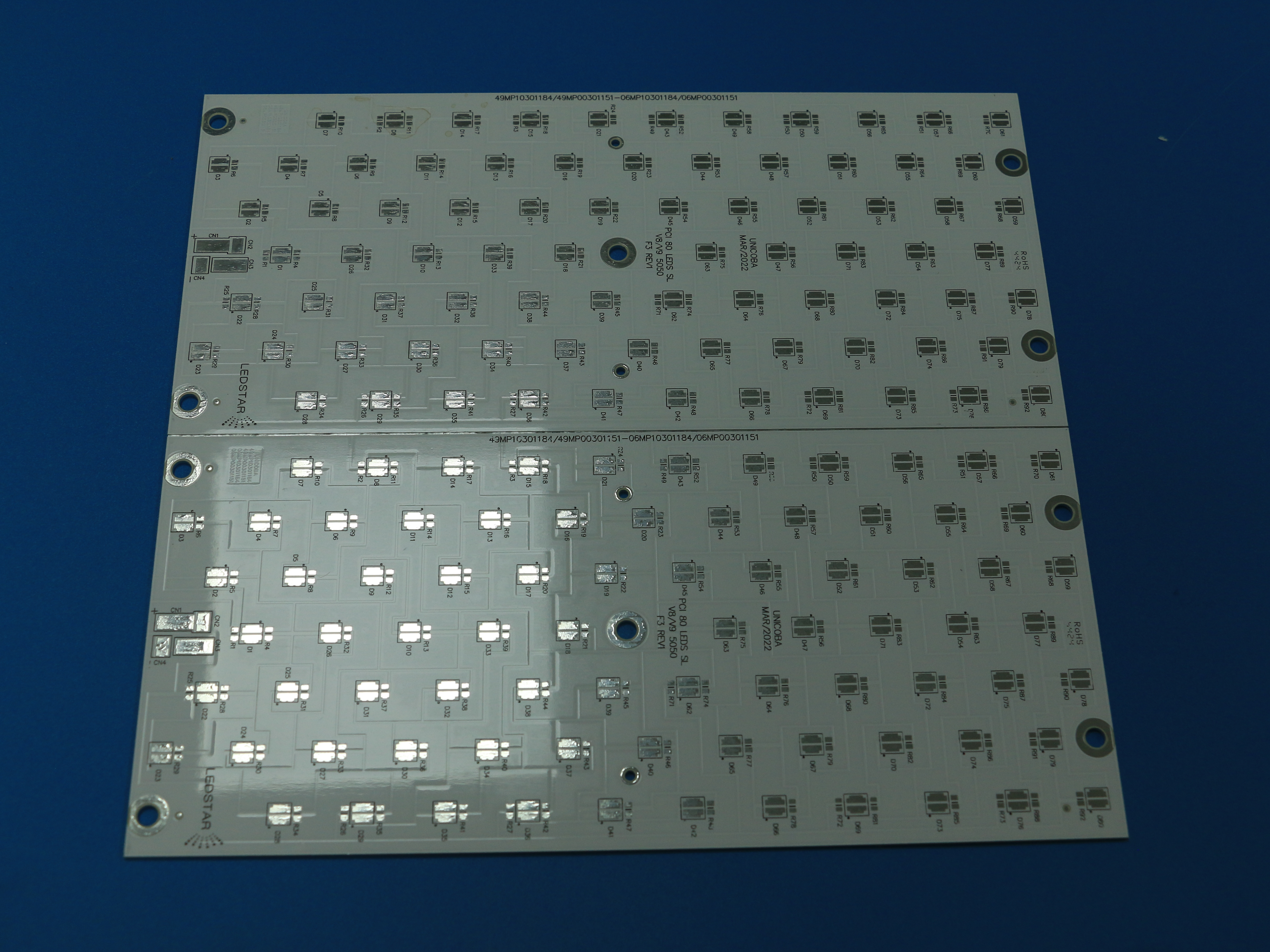
The Coverlay MCPCB — listed as the Coverlay Aluminium PCB — is a single-sided board with an Al1060 aluminum base, 1 oz copper foil and an overall thickness of 1.6 mm ±10%. Its panel measures 208.00 mm × 225.00 mm and is delivered two units per panel. The solder mask is specified as white coverlay, the silkscreen is black, the surface finish is HASL-LF, and the stated application is the lighting industry.
The field that distinguishes this build from the other single-sided aluminum boards is the mask: it is named as a coverlay rather than as a colour. Because the published record does not state whether that coverlay is a film system or a liquid photoimageable mask, a buyer whose assembly process depends on the difference should confirm the mask type on the drawing before approving the stack-up.
MCPCB for Road Lighting (Al1060 Base)
The MCPCB for road lighting is a single-sided Al1060 board with 1 oz copper foil, an overall thickness of 1.6 mm ±10% and a 208.00 mm × 225.00 mm panel delivered as two-up. The solder mask is white, the silkscreen is black, the surface finish is HASL-LF, and the stated application is road lighting within the lighting industry.
Structurally this board and the Coverlay MCPCB share the same base grade, the same copper weight, the same thickness and tolerance, and the same panel format. The mask system and the product designation are what differ. That is a useful observation during evaluation: two entries that read as separate products can share one substrate platform, so a quotation comparison should be made field by field rather than by product name.
MCPCB for Motor Lighting (Al5052 Base)
The MCPCB for motor lighting is a single-sided Al5052 aluminum board with 1 oz copper foil and an overall thickness of 1.6 mm ±10%. Its panel is 243.00 mm × 243.00 mm at one unit per panel. The solder mask is matt black, the silkscreen is white, the surface finish is HASL, and the stated application is motor lighting.
Two fields separate this build from the road-lighting board. The base grade changes from Al1060 to Al5052, and the panel grows to 243.00 mm square with a single unit per panel instead of a two-up layout. Al1060 and Al5052 are different aluminum grades; the published specification gives the designation but not the mechanical or thermal values behind it. A buyer substituting one grade for the other during a re-qualification should therefore ask for the grade datasheet rather than assume the two are interchangeable, and should re-check the panel format, because a different panel changes how the board is produced and shipped.
High Voltage MCPCB
The High Voltage MCPCB is a single-sided aluminum board with 1 oz copper foil, an overall thickness of 1.6 mm ±10% and a 243.00 mm × 243.00 mm panel at one unit per panel. The solder mask is white, the silkscreen is black, the surface finish is OSP, the stated application is lighting, and the product record also notes suitability for OEM applications.
The product name describes an intended electrical duty, and that is exactly where the published construction data stops. The record lists the base metal, the copper weight, the thickness and the finish; it does not list a rated voltage, a dielectric breakdown value, or creepage and clearance figures. That does not mean the board lacks them. It means they are not part of the specification a buyer sees first, so a high-voltage design review should request the electrical test data and the relevant declaration before the design is locked.
Double-Sided Aluminum, Copper, and Ceramic: When One Copper Layer Is Not Enough
The remaining three builds in this set leave the single-sided aluminum template in three different directions: two copper layers on an aluminum base, two copper layers on a copper base, and a ceramic base with a very different data profile.
Double sided MPCB (Al5 Base, Two Copper Layers)
The Double sided MPCB is a double-sided aluminum-based board built on Al5 material. The copper foil is specified as 70/70 µm — a paired value giving a copper thickness for each side — and the overall thickness is 1.6 mm ±0.16 mm. The panel is 217.54 mm × 197.80 mm with 56 units per panel. Solder mask is white on both sides, silkscreen is black on both sides, the surface finish is HASL-LF, and the stated application is home application.
Two things are worth reading slowly here. First, the copper value is given in micrometres rather than in ounces, so it must be converted or confirmed before it is compared with the 1 oz foil on the single-sided boards. Second, the tolerance is written as ±0.16 mm rather than as a percentage; ±10% of 1.6 mm is ±0.16 mm, so the two notations describe the same window, expressed differently. Buyers comparing quotations across suppliers should normalise the notation before drawing any conclusion.
Thermoelectric Separated Cu based PCB (Copper Base, 35 µm Foil)
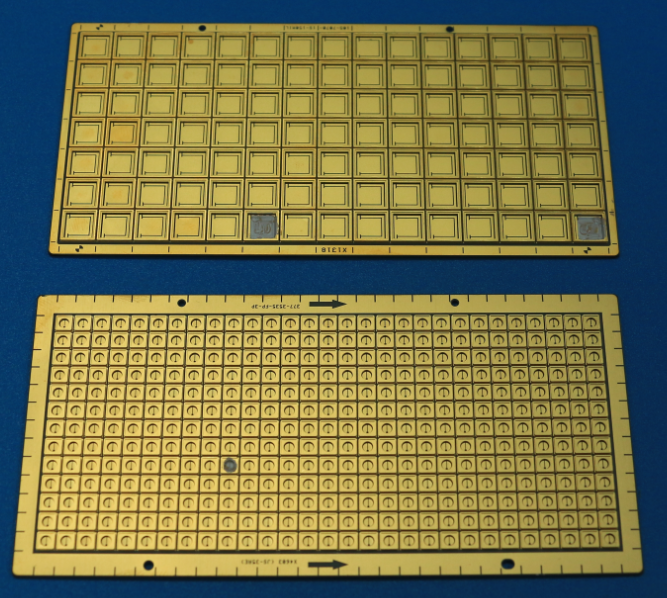
The Thermoelectric Separated Cu based PCB is a double-sided copper-based substrate built with a thermoelectric separation construction. The copper foil thickness is 35 µm, the overall thickness is 1.6 mm ±0.16 mm, and the panel is 133.80 mm × 120.00 mm at four units per panel. The solder mask is white, the silkscreen is black, the surface finish is OSP, and the stated application is the lighting industry.
The base metal here is copper rather than aluminum, and the product name adds a construction concept rather than a material grade. What the record gives you is the build: copper base, two copper layers at 35 µm, 1.6 mm ±0.16 mm overall, a small four-up panel and an OSP finish. What it does not give is the dielectric system, the thermal resistance of the stack, or any measured thermal performance figure. If your design depends on the separation of the thermal and electrical paths, ask the supplier to describe the layer construction and to provide the supporting data — the product name alone is not a specification.
Ceramic based PCB for Ultraviolet Phototherapy
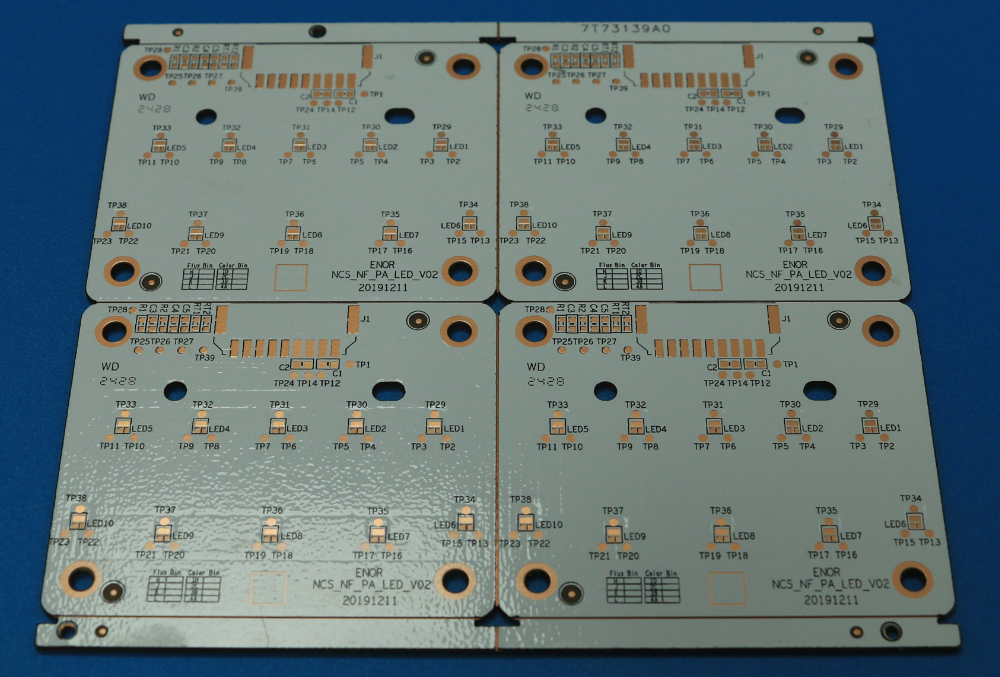
The Ceramic based PCB is constructed from ceramic material and is designated for ultraviolet phototherapy applications. That is the full extent of the published record for this item: base material and intended application. Layer count, overall thickness, copper foil thickness, panel size, solder mask and surface finish are not stated in the specification reviewed here and must come from the drawing or the quotation.
For a buyer, this is the clearest illustration of why material-first sorting matters. A ceramic board and an aluminum board are not two versions of the same product at different prices; they are different substrate families, and the ceramic item in this set is documented at a much shorter level of detail than the aluminum builds. Treat the shorter record as a prompt for questions, not as evidence that the board is simpler.
Construction Comparison: Seven Builds, One Table
The table below places the seven builds side by side using only the fields that appear in their published specifications. A dash means the available record does not state that field; it is not a statement that the board cannot be produced with it.
| Build | Base material | Layers | Copper foil | Overall thickness | Panel size | Surface finish / mask | Stated use |
|---|---|---|---|---|---|---|---|
| Coverlay MCPCB | Al1060 | Single-sided | 1 oz | 1.6 mm ±10% | 208.00 × 225.00 mm, 2-up | HASL-LF; white coverlay mask, black silk | Lighting |
| MCPCB for road lighting | Al1060 | Single-sided | 1 oz | 1.6 mm ±10% | 208.00 × 225.00 mm, 2-up | HASL-LF; white mask, black silk | Road lighting |
| MCPCB for motor lighting | Al5052 | Single-sided | 1 oz | 1.6 mm ±10% | 243.00 × 243.00 mm, 1-up | HASL; matt black mask, white silk | Motor lighting |
| High Voltage MCPCB | Aluminum | Single-sided | 1 oz | 1.6 mm ±10% | 243.00 × 243.00 mm, 1-up | OSP; white mask, black silk | Lighting, OEM |
| Double sided MPCB | Al5 | Double-sided | 70/70 µm | 1.6 mm ±0.16 mm | 217.54 × 197.80 mm, 56-up | HASL-LF; white/white mask, black/black silk | Home application |
| Thermoelectric Separated Cu based PCB | Copper based | Double-sided | 35 µm | 1.6 mm ±0.16 mm | 133.80 × 120.00 mm, 4-up | OSP; white mask, black silk | Lighting |
| Ceramic based PCB | Ceramic | — | — | — | — | — | Ultraviolet phototherapy |
Two patterns are visible once the table is assembled. First, all four single-sided aluminum boards sit at the same 1.6 mm ±10% thickness with 1 oz foil, which means thickness alone cannot be used to tell them apart — only the base grade, the mask and the panel format can. Second, the three double-sided and non-aluminum builds are the ones carrying distinct copper values (70/70 µm and 35 µm) and a tighter-looking tolerance notation, which is where a like-for-like quote comparison has to start.
Step-by-Step: How to Read an MCPCB Specification in Six Checks
The same six checks apply to every board in this family, and running them in order takes only a few minutes per quotation.
- Confirm the base material and its grade. Write down the exact designation — Al1060, Al5052, Al5, copper based, ceramic — rather than the generic word "aluminum". If a quotation lists only "aluminum", ask which grade is being offered, because the four single-sided builds here already use three different base designations.
- Count the copper layers. Single-sided and double-sided are different constructions and different production routes. In this family, the first four builds are single-sided and the Double sided MPCB and Thermoelectric Separated Cu based PCB are double-sided.
- Read the copper foil value together with its unit. The single-sided aluminum boards use 1 oz, while the double-sided copper-based board uses 35 µm and the double-sided aluminum board uses 70/70 µm. Ounces and micrometres are not directly readable against each other, so confirm the unit before you compare two quotations.
- Check overall thickness and the tolerance notation. This set is built at 1.6 mm throughout, but written two ways: ±10% on the aluminum builds and ±0.16 mm on the double-sided builds. ±10% of 1.6 mm equals ±0.16 mm, so the window is the same; normalising the notation prevents an apparent difference from being read as a real one.
- Identify the mask and finish system. HASL-LF is the lead-free hot-air solder levelling designation, HASL appears without the suffix on the motor-lighting build, and OSP appears on the High Voltage and copper-based boards. The mask field also differs: white, matt black, white over black, and a named white coverlay. Finish and mask affect assembly and storage conditions, so they belong in the comparison even when they are not the focus.
- Read the panel size and units per panel. The figures in this family range from 208.00 × 225.00 mm at two-up to 217.54 × 197.80 mm at 56-up. Panel format is the field most often dropped from a short quotation, and without it two prices cannot be compared.
Use-Case Fit: Which Build Answers Which Question
The stated applications in these specifications give a first-pass map. Road luminaires point to the Al1060 single-sided road-lighting board. Two-wheeler lamps point to the Al5052 motor-lighting board, with its matt black mask and single-unit 243.00 mm panel. High-voltage lighting and OEM lighting work point to the High Voltage MCPCB with its OSP finish. Home-application designs that need two copper layers point to the Double sided MPCB. Lighting designs built around a thermoelectric separation construction point to the copper-based board. Ultraviolet phototherapy points to the Ceramic based PCB. And where an assembly depends on a coverlay mask, the Coverlay MCPCB is the relevant build.
Read those mappings as the manufacturer's stated application, not as a qualification for your specific design. The application field tells you what the board was documented for; it does not tell you whether your thermal, dielectric or reliability requirement is met. That has to be checked against the design calculation and the supplier's test documents.
What These Specifications Do Not Establish
Being explicit about the gaps is part of reading a construction record properly.
- None of the seven published records reviewed here states a thermal conductivity or thermal resistance value, so no ranking of thermal performance between these builds can be derived from them.
- The High Voltage MCPCB carries an intended-duty name but no rated voltage, dielectric breakdown value, or creepage and clearance figure in the published record.
- The Ceramic based PCB record covers only the base material and the ultraviolet phototherapy application; its layer count, thickness, copper foil and finish are not published in the specification used here.
- No MOQ, price, lead time, tooling or payment terms appear in any of the records, so cost comparison is not possible from the data alone.
- All seven records come from a single manufacturer's product documentation. Cross-supplier comparison requires equivalent fields from each supplier, collected on the same basis.
The practical response to these gaps is a short document request: the fabrication drawing, the base-material grade datasheet, the finish and mask specification, the panel drawing, and whichever test reports your application requires. A supplier who can answer those five items with documents is easier to qualify than one who answers with adjectives.
About the Manufacturer Behind These Boards
WODE Circuit Technology (Zhuhai) Co., Ltd. is a PCB and FPC manufacturer established in 2003, operating a 150,000 m² facility with approximately 500+ staff and an annual production capacity of 6,000,000 sqm. Its product range covers rigid MCPCB, FPCB, infinity-length FPCB, FR-4/CEM1/CEM3 PCBs and CCL, and PCB inks, supported by an R&D team of 15 engineers and more than 40 patented technologies. The company has passed ISO9001, ISO14001 and IATF16949 international certifications, and its products comply with UL, RoHS and REACH standards. Full company and product information is available at WODE Circuit Technology (Zhuhai) Co., Ltd.
Frequently Asked Questions
Who are MCPCB manufacturers, and how does a buyer identify one?
MCPCB manufacturers are board fabricators that build metal-clad substrates — aluminum, copper or ceramic base — rather than standard FR-4 boards. Because the product name is used loosely, the reliable way to identify one is to check four things: whether the published product range actually includes metal base boards, which base grades and stack-ups are documented, which quality systems and product-compliance certifications are held, and whether the factory data is specific enough to be verified. WODE Circuit Technology (Zhuhai) Co., Ltd., for example, lists rigid MCPCB among its main products and documents ISO9001, ISO14001, IATF16949, UL, RoHS and REACH positions; a buyer should still request the certificate copies and the drawings for the exact boards being quoted.
What is the difference between a single-sided and a double-sided MCPCB in this family?
In this set, single-sided describes the four aluminum boards with one 1 oz copper foil layer: the Coverlay MCPCB, the MCPCB for road lighting, the MCPCB for motor lighting and the High Voltage MCPCB. Double-sided describes the Double sided MPCB, built on Al5 with a 70/70 µm copper foil value, and the Thermoelectric Separated Cu based PCB, built on a copper base with 35 µm copper foil. All seven are nominally 1.6 mm overall; the difference is the number of copper layers, the base metal and the copper weight notation.
Does a heavier copper foil automatically mean better performance?
The published construction records do not support that conclusion either way. They state copper foil values — 1 oz on the single-sided aluminum boards, 35 µm on the copper-based board and 70/70 µm on the double-sided aluminum board — but they do not state current-carrying capacity, thermal performance or measured electrical results. The units also differ between products, so the first step is to confirm the unit and the number of layers, and the second is to ask the supplier for the design data relevant to your application.
Is a ceramic PCB part of the MCPCB family?
Yes. Metal core and ceramic substrates belong to the same broad family of boards that use a non-FR-4 base to carry the circuit, and the Ceramic based PCB in this set is documented for ultraviolet phototherapy. It is not a variant of an aluminum board, however: the base material is ceramic, and the published record for this item covers only the base material and the intended application. Layer count, thickness, copper foil and finish must be confirmed from the drawing.
What should I request before choosing a base material?
Request five items: the fabrication drawing showing layer count and stack-up, the base-material grade datasheet (Al1060, Al5052, Al5, copper or ceramic), the copper foil value with its unit, the overall thickness with its tolerance, and the mask and surface finish specification. Add the panel drawing if your costing depends on units per panel, and add electrical or thermal test reports if your design depends on them. A sample built to your drawing is the natural last step: it lets you confirm the stack-up and the finish against your own assembly process before committing to volume. The WODE product brochure can be downloaded here, and a sample or quotation request can be raised with the engineering team once your drawing is ready.
Conclusion
Sorting MCPCBs by core material turns a confusing catalogue into a short, checkable list. Four of the builds here are single-sided aluminum boards sharing one 1.6 mm ±10%, 1 oz skeleton, separated only by base grade, mask and panel format. Two are double-sided builds on aluminum and copper with their copper weights written in micrometres, and one is a ceramic board documented for ultraviolet phototherapy. Base material, layer count, overall thickness and copper foil thickness identify the category in minutes; everything beyond that — thermal data, dielectric strength, reliability testing, commercial terms — has to be requested, and knowing exactly what to request is the real output of reading a construction record.
Next Step
If you are narrowing a design to one of these builds, the fastest way to confirm fit is to compare your drawing against the published construction fields and then request a sample built to that stack-up. The full WODE MCPCB range, including single-sided aluminum, double-sided and ceramic substrates, is documented in the company brochure: download the WODE product brochure.
Have Questions or Need More Details?
Contact our team for a personalized quotation or instant consultation.
Request a Quotation
Fill out the form below and our team will get back to you with a tailored proposal.
WhatsApp Direct Chat
Prefer to chat in real-time? Message us on WhatsApp for instant assistance & quick answers.
- Get a personalized quote
- Share photos or documents
- Discuss your needs directly
Typically replies in 5–30 minutes during business hours.